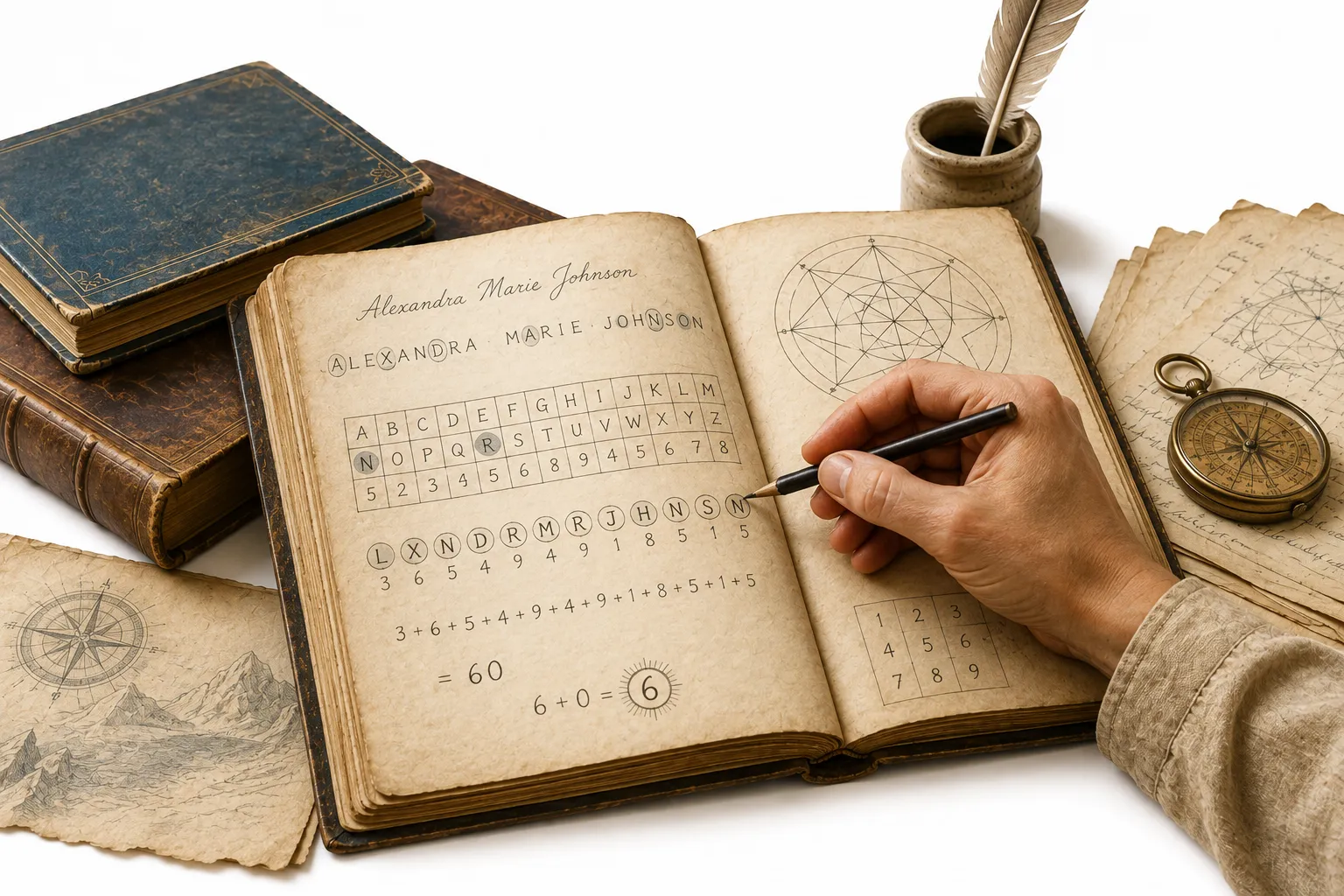
Take a name, remove every vowel, and what's left is a kind of consonant skeleton — the part of a word you could still recognize with the breath knocked out of it.
That skeleton is the entire raw material for a personality number. Everything from here is just arithmetic.
Quick answer
To calculate a personality number, write out your full birth name, identify every consonant (every letter that isn't A, E, I, O, or U, including Y), convert each to a number using a Pythagorean letter chart, sum the results, and reduce to a single digit — preserving 11, 22, or 33 if your method treats them as master numbers.
This walkthrough shows one common convention. It does not establish that the resulting number reveals anything true about how a person is perceived.
Consonants in Full Birth NameInput
Digit ReductionMethod
Often KeptMaster Numbers
Counted as a ConsonantY Handling
01Overview
Overview
Same letter chart, the other half of the name
Arithmetic can be checked
The personality number leans on the same nine-column Pythagorean letter chart used for the expression and soul urge numbers. The only thing that changes is which letters get counted — here, everything except A, E, I, O, and U.
Below is one transparent worked example, using only the consonants of a sample name, so the arithmetic is visible before any interpretation begins.
02STEPS
The basic steps
Write out the full birth name exactly as it appears on the birth record — first, middle, and last.
Identify the consonants: every letter that is not A, E, I, O, or U, including Y in every position.
Convert each consonant to a number using the Pythagorean chart, then sum every value.
Reduce the total to a single digit, unless the sum lands on 11, 22, or 33 and your convention preserves master numbers.
03EXAMPLE
Worked example
Sum the numeric values of every consonant in the full birth name, then reduce to a single digit, preserving 11, 22, and 33.
Name: THOMAS HENRY CLARK
Input: THOMAS HENRY CLARK
1. Isolate the consonants
T, H, M, S, H, N, R, Y, C, L, R, K = 0
Thomas contributes T, H, M, S; Henry contributes H, N, R, Y; Clark contributes C, L, R, K.