Number Rules

Is 10 a Life Path Number?

Ten looks tidy — a full hand of fingers, a round decimal marker — but in life path arithmetic it's a rest stop, not a destination.

The rule that erases it is the same one that lets 11 survive one line later.

Quick answer

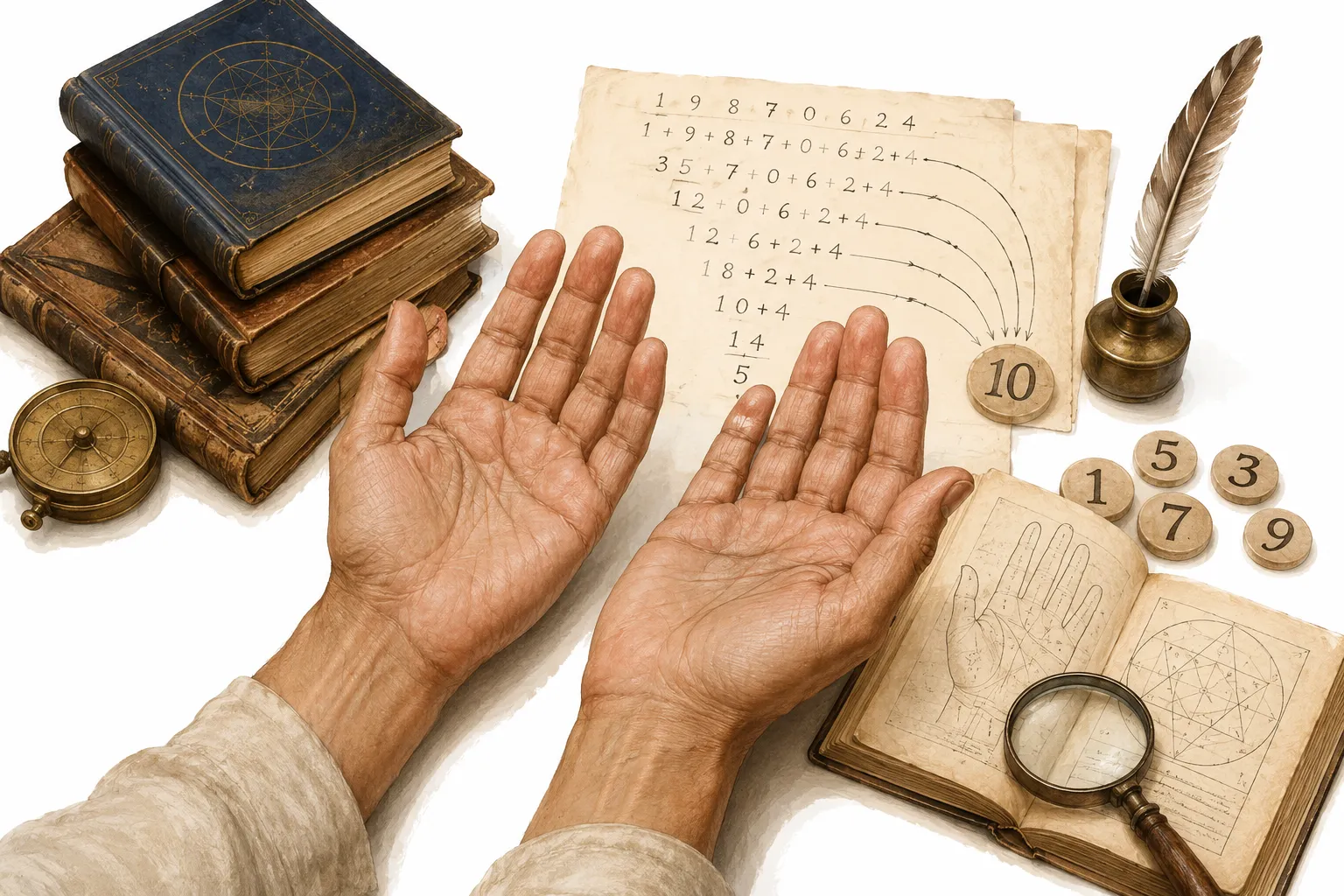
No. In the standard Western method, 10 is always reduced further: 1 + 0 = 1. A life path number of 10 doesn't appear as a final result — it becomes 1.

This explains a fixed calculation rule, not a claim about what any resulting number means for a person.

The number 10 with an arrow reducing it to 1
NoValid Final Number?
1Reduces To
NoMaster Number?
Intermediate Total OnlyAppears As
01Overview

Overview

Why the list stops at 9 — with two exceptions

Arithmetic can be checked

Standard Western life path numbers land somewhere between 1 and 9, with 11, 22, and 33 kept as special cases by most practitioners. Ten isn't on either list.

That's because the whole method is built to end in a single digit. Any two-digit total, including 10, is just a waypoint — you add its digits together and keep going.

Ten happens to reduce cleanly: 1 + 0 = 1, with nothing left over to debate.

02WHY NOT 10

Where a total of 10 comes from, and where it goes

A running total hits 10 fairly often mid-calculation — it's an easy sum to land on with birthdate digits. But the reduction rule doesn't stop just because the number looks whole.

1 + 0 = 1. So anyone whose digits sum to 10 at any stage ends up with a life path number of 1, not 10.

03NEARBY TOTALS

How nearby totals resolve

Reduced

99

9 stays 9

Already a single digit — nothing to reduce.

Reduced

101

10 becomes 1

1 + 0 = 1.

Preserved

1111

11 is preserved

Most Western schools treat 11 as a master number and stop reducing.

Reduced

123

12 becomes 3

1 + 2 = 3.

04NOTE

Not every school agrees on everything

The reduction rule for 10 is essentially universal — no mainstream Western tradition keeps it unreduced. Disagreement between schools shows up around master numbers like 11, 22, and 33, not around ordinary two-digit totals like 10.