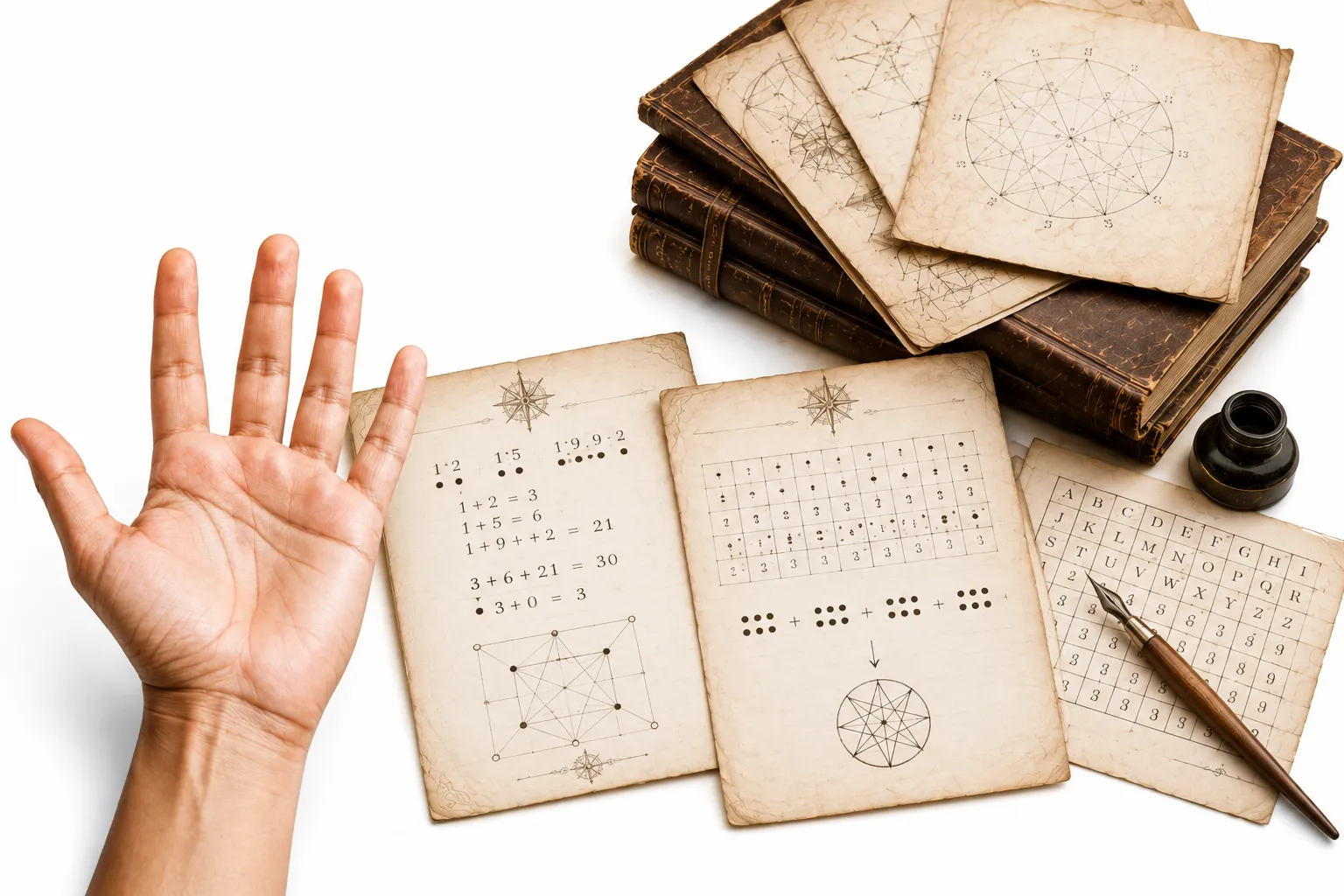
Definitions

What Is a Birth Number and a Destiny Number?

Every birth date holds two different numbers inside it, and numerology never lets you forget it — it just never explains, up front, why you need both.

One number ignores almost the whole date on purpose. The other refuses to ignore any of it. That contrast is the actual definition worth learning — the digits are the easy part.

Quick answer

The birth number (sometimes called the root number, or mulank) is calculated from the day of the month you were born, reduced to a single digit — someone born on the 17th has a birth number of 8 (1+7). The destiny number is calculated from your entire birth date — day, month, and year all added together and reduced. They're companion numbers in most Indian numerology systems, each said to describe a different layer of the same person.

This defines two numerology calculations and the tradition attached to them. It does not assert that either number reveals real information about a person's character or future.

A birth certificate date split into a single circled day and the full date beneath it
Day of MonthBirth Number Input
Full Date (Day + Month + Year)Destiny Number Input
A Single DigitBoth Reduce To
Mulank / BhagyankAlso Called
01Overview

Overview

Two lenses on the same date

Interpretation is traditional

If you've only ever encountered Western numerology, "birth number" and "destiny number" both sound like they should mean the life path number — the one calculation everyone eventually lands on. Indian numerology, though, tends to keep the two separate on purpose, treating the day of birth and the full birth date as two different sources of information.

The birth number is the smaller of the two jobs. Look at the calendar day you were born — nothing else — and reduce it. Someone born on the 4th, the 13th, the 22nd, or the 31st all end up in the same place: a birth number of 4.

The destiny number widens the lens to the entire date. Day, month, and year all get summed together, digit by digit, and reduced the same way. It's a heavier calculation working with more raw material, and in most schools it's treated as describing something broader — a life direction rather than a surface trait.

02BIRTH NUMBER

Calculating the birth number

Take the day of the month you were born and reduce it to a single digit.

Born on the 28th

Input: 28

  1. 1. Sum the digits of the day

    2 + 8 = 10

    Only the day of the month is used — month and year are ignored entirely.

  2. 2. Reduce again

    1 + 0 = 1

    Most Vedic-style methods reduce all the way to a single digit, without preserving 10, 11, or similar totals.

Result: 1

  • • Accidentally including the month or year in the sum
  • • Assuming the birth number and destiny number should match — they usually won't
03DESTINY NUMBER

Calculating the destiny number

Add every digit of the full birth date — day, month, and year — and reduce to a single digit.

Born 28 June 1997

Input: 1997-06-28

  1. 1. Sum all digits

    2 + 8 + 0 + 6 + 1 + 9 + 9 + 7 = 42

    Every digit from the day, month, and year is included this time.

  2. 2. Reduce the total

    4 + 2 = 6

Result: 6

Note the gap: this person's birth number was 1 (from the 28th), but their destiny number is 6 — two different numbers describing two different things.

04WHY TWO NUMBERS

Why keep two numbers instead of merging them

The honest answer is that it gives a reading system more to work with. A birth number said to reflect an immediate, visible temperament and a destiny number said to reflect a longer, slower-moving direction lets a numerologist tell a two-act story instead of a one-line verdict. Whether that story tracks anything real about the person is exactly the part that stays in the realm of belief rather than measurement — but as a piece of design, having two complementary numbers rather than one is a reasonable way to build a richer narrative framework.

05TAKEAWAYS

Verdict

Birth number: day of birth only, reduced to one digit.

Supporting Finding

Destiny number: entire birth date, reduced to one digit.

Important Limit

The two numbers are usually different — that's expected, not an error.

Reading Context

Meaning attached to either number is tradition, not measurement.