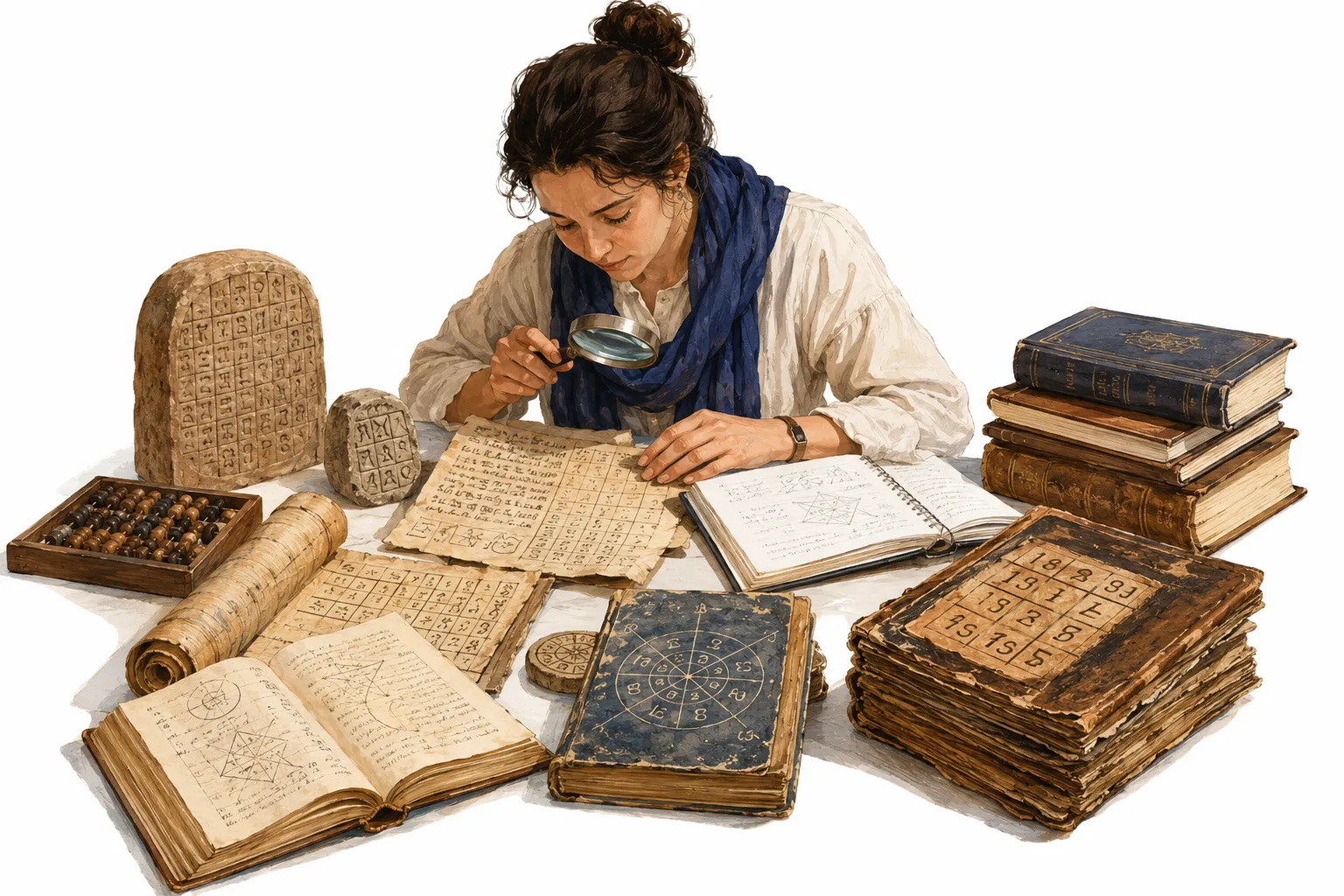
Where Do Life Path Numbers Come From? Ancient Associations and Modern Methods
If you ask modern numerology websites where life path numbers come from, the standard response is immediate and confident: "Pythagoras invented life path numbers 2,500 years ago in ancient Greece."
When historians and bibliographers inspect surviving ancient Greek texts and early numerology manuals, a very different story emerges. While numerical philosophy is ancient, the specific calculation of adding a month, day, and year of birth to produce a "life path number" is a modern invention, formalized in the United States between 1908 and 1965.
This investigation traces the documented textual evolution of birth-date calculations, comparing early 20th-century original manuals with modern calculator conventions.
Attributing the modern life path formula directly to Pythagoras is like crediting Isaac Newton with inventing the smartphone because he discovered the laws of optics.
Quick answer
Ancient Greek and Hebrew scholars practiced numeric symbolism (gematria and arithmology), but they did not calculate life path numbers from calendar dates. The birth-date reduction system was created in the early 1900s by American New Thought author Mrs. L. Dow Balliett, refined by Florence Campbell (1931), and popularized as the "Life Path" by Juno Jordan (1965).
This article evaluates documented historical literature. It makes no claims regarding the spiritual or predictive validity of numerical interpretations.
Pythagorean Arithmology (Symbolic Only)Ancient Foundation
Mrs. L. Dow Balliett (1908)Formula Originator
Florence Campbell & Juno JordanTerm Popularizer
1908 – 1931 ManualsMaster Numbers Introduced
01Overview
Historical Scope
Distinguishing Ancient Philosophy from Modern Calculation Formulas
Historical account
A core error in popular numerology is confusing general number symbolism with a specific mathematical formula. Interested readers often assume that because ancient civilizations attached meaning to numbers 1 through 9, they must have calculated birth-date totals using the modern Gregorian calendar.
In reality, the ancient Greeks used different calendar systems, had no single "Life Path" concept, and evaluated character through name letter totals (isopsephy). The formula of reducing a birth month, birth day, and birth year down to a single digit (or master number) arose in early 20th-century North America.
02TIMELINE
Documented Historical Timeline of Birth-Date Numerology
Unsupported numerology section type in development: timeline
03KEY DISTINCTION
The Most Revealing Distinction: Isopsephy vs Birth-Date Reduction
The most important distinction in numerological history is the shift from letter-based calculation (isopsephy) to calendar date reduction.
In antiquity, when a scholar evaluated an individual numerically, they calculated the sum of the letters in their spoken name using the Greek or Hebrew alphabet. They did not add together their birth day, month, and year.
Birth-date reduction required two historical prerequisites that did not exist in ancient Greece: widespread adoption of the modern Gregorian calendar (standardized in 1582) and Hindu-Arabic decimal numerals (introduced to Western Europe in the 12th century). Without decimal place-value arithmetic, reducing 1984 to 1 + 9 + 8 + 4 = 22 = 4 was mathematically impossible.
04METHOD COMPARISON
Calculation Comparison: Three Documented Reduction Methods
Calculation Comparison: Three Documented Reduction Methods
05ORIGIN MYTHS
Assessing Common Origin Claims
Myth
Claim 1: "Pythagoras created the Life Path formula."
Reality
Historical Audit: Unverified. Pythagoras focused on sacred geometry and number properties (monad, dyad, tetraktys). No birth-date reduction formulas exist in surviving Greek fragments.
Myth
Claim 2: "Life Path numbers come from ancient Chaldean tablet readings."
Reality
Historical Audit: Incorrect. The Chaldean numerology system focuses on name letter vibrations matched to astrological planets. It did not use birth-date reduction to single digits.
Myth
Claim 3: "Master numbers 11 and 22 have been preserved since antiquity."
Reality
Historical Audit: Documented 1908 Origin. Mrs. L. Dow Balliett introduced the rule that 11 and 22 represent higher octave vibrations that should not be reduced further.
06PRACTICAL GUIDANCE
What This History Means for Someone Using a Calculator Today
Understanding the history of life path numbers provides clarity for anyone using an online calculator:
1. Convention Choice Matters: If a calculator gives you a different Life Path number than another site, it is likely because one uses Period Reduction (Method 1) while the other uses Single-Sum Reduction (Method 2).
2. Respect Master Number Rules: Modern consensus follows Florence Campbell's 1931 rule: preserve 11, 22, and 33 during intermediate reduction steps so that master vibrations are not lost.
3. Value Symbolic Insight Over Ancient Authority: Life path numbers are a rich early-20th-century psychological self-reflection framework. They do not require a fake 5,000-year ancient pedigree to be meaningful to practitioners today.
07CONTINUE
Continue exploring
Related Numerology Guides
Stay with the calculation, the meanings, or the evidence boundary—whichever question the result actually raised.