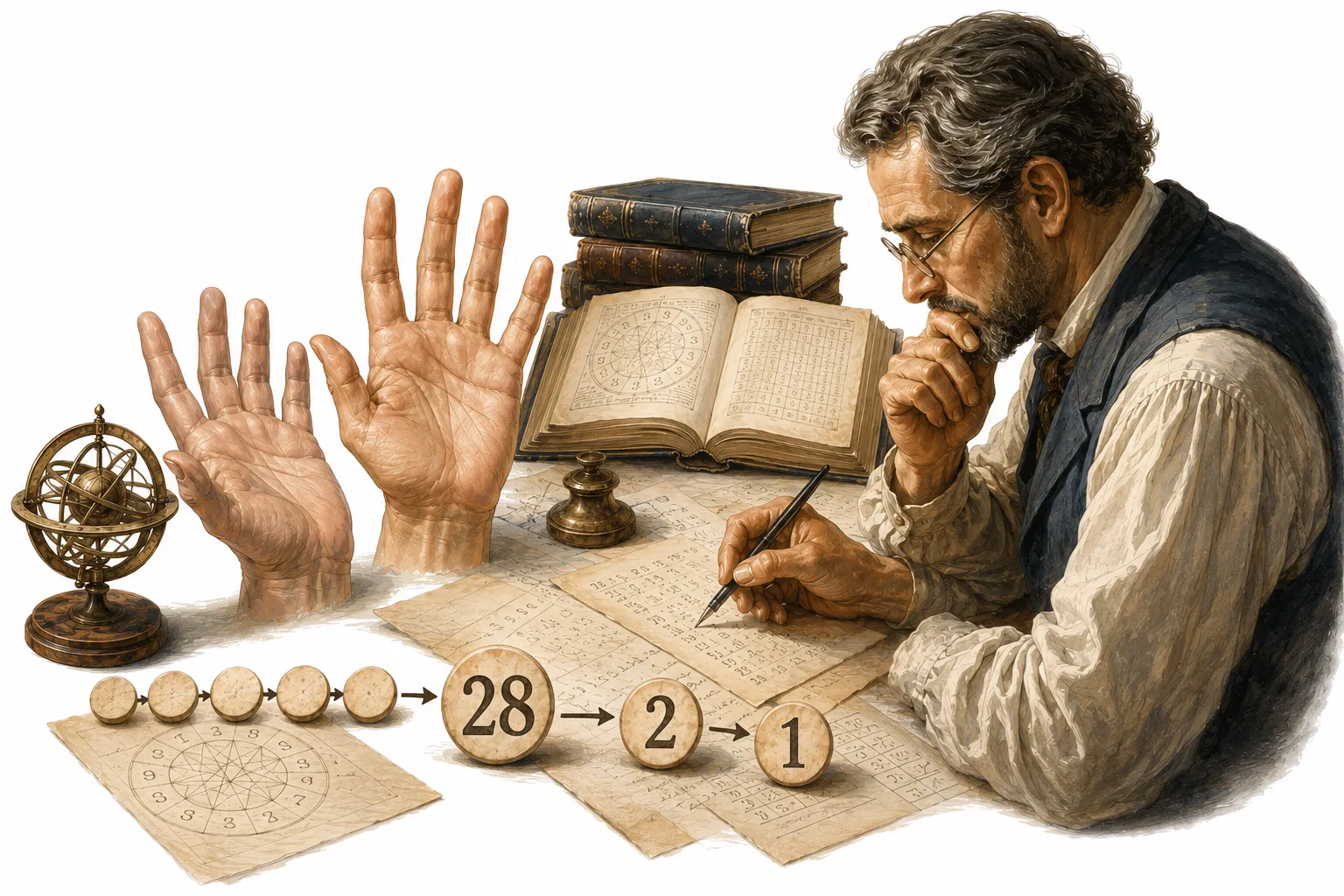
Twenty-eight is a bigger total than most life path calculations produce, which makes it a useful case for watching the reduction rule work more than once.
It doesn't stop at the first pass — it takes a second trip through the same rule before it settles.
Quick answer
No. 28 reduces in two steps: 2 + 8 = 10, then 1 + 0 = 1. The final life path number is 1, and 28 never survives as a standalone result.
This explains a fixed calculation rule, not a claim about what the resulting number means.
NoValid Final Number?
1Reduces To
2Reduction Steps
NoMaster Number?
01Overview
Overview
A number that needs two passes
Arithmetic can be checked
Most birth-date sums that people ask about are a single reduction away from a final digit. 28 is a reminder that the rule is "keep reducing until one digit remains," not "reduce exactly once."
2 + 8 = 10 first. Then, since 10 is not a preserved master number, it reduces again: 1 + 0 = 1.
02TWO STEPS
Watching both steps happen
First pass: 2 + 8 = 10. This is still a two-digit number, so the process isn't finished.
Second pass: 1 + 0 = 1. Now it's a single digit, and the reduction stops there. The final life path number is 1 — the same result you'd get from a much simpler total.
03FULL REDUCTION
Full reduction of 28
Reduce a total repeatedly until one digit remains, preserving 11, 22, and 33.
Starting total: 28
Input: 28
1. First reduction
2 + 8 = 10
2. Second reduction
1 + 0 = 1
10 is not a preserved master number, so it reduces again.
Result: 1
04CONTINUE
Continue exploring
Related questions
Stay with the calculation, the meanings, or the evidence boundary—whichever question the result actually raised.