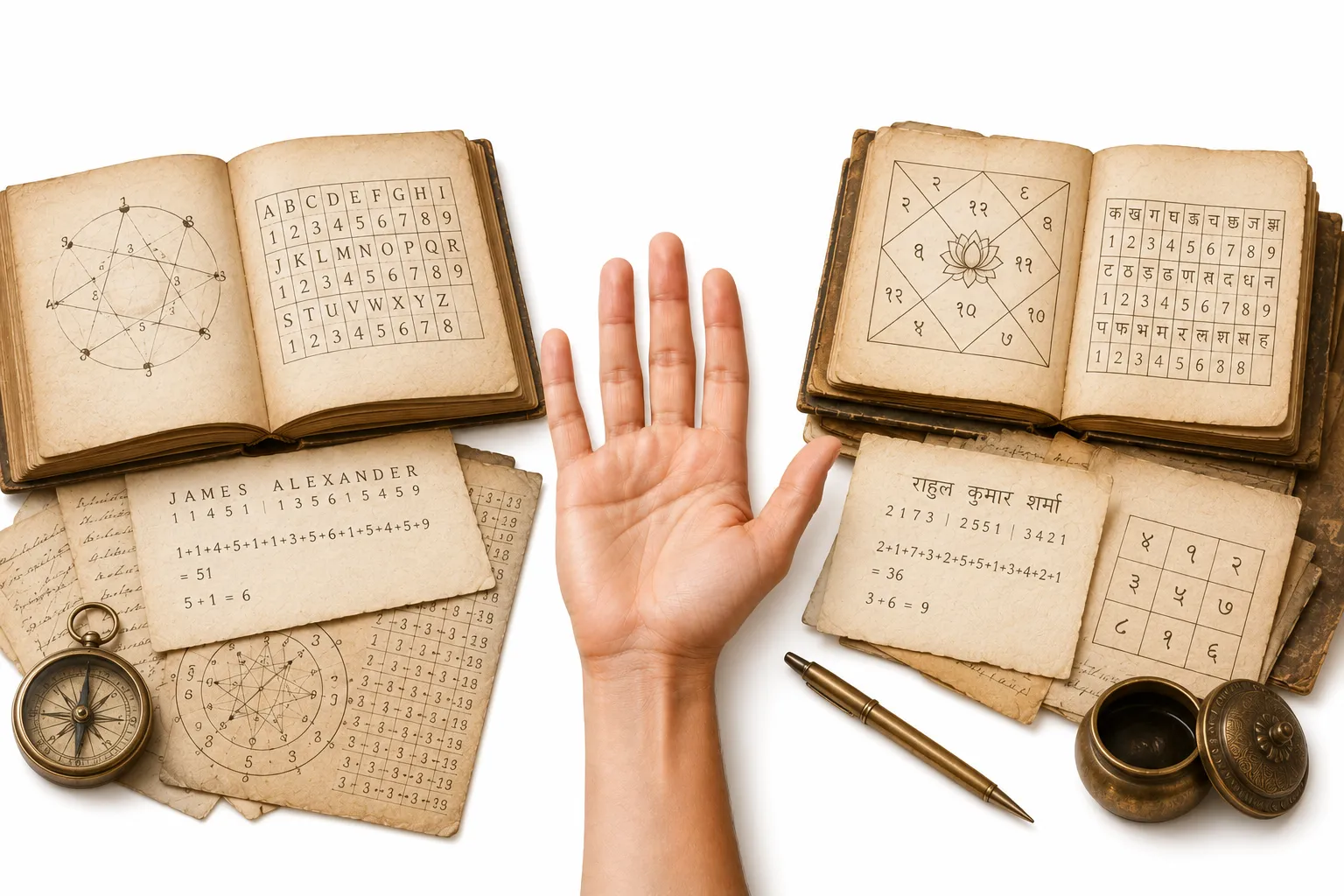
Terminology

Is Destiny Number the Same as Bhagyank?

Bhagyank is Sanskrit-derived — bhagya means fortune, ank means number. Translate it directly and you get "fortune number." Translate it loosely, the way most English numerology sites do, and you get "destiny number."

The translation is doing more work than it looks like, because "destiny number" isn't one fixed calculation in English-language numerology — it's used for at least two different things, and only one of them matches bhagyank exactly.

Quick answer

Yes, in most everyday usage: bhagyank is the term used in Indian (Vedic-influenced) numerology for the number calculated by adding every digit of your full birth date and reducing it to one digit — which is exactly what English-language sites usually mean by "destiny number." The wrinkle is that a smaller number of Western numerologists use "destiny number" to mean something calculated from your name instead, so the two terms aren't guaranteed to match unless you check which method the site is actually using.

This page compares terminology and calculation method across two traditions. It does not claim either number reveals anything true about a person's fortune or fate.

Two number wheels, one labeled bhagyank and one labeled destiny number, overlapping
Full Birth DateBhagyank Input
Full Birth DateTypical "Destiny Number" Input
Full Birth NameAlternate Usage
Usually Not Kept in Vedic MethodMaster Numbers
01Overview

Overview

Same arithmetic, different shelf

Interpretation is traditional

Numerology didn't arrive at its vocabulary through a single committee. It grew up in parallel in different places — Pythagorean Greece, medieval Kabbalah, and Vedic India all produced number systems that solved a similar human itch (find meaning in a birth date or a name) with their own words for the results.

Bhagyank sits comfortably inside that Indian tradition. It's built from the birth date — day, month, and year, every digit added together and reduced — the same raw material Western sites use for what they usually call the life path number or, confusingly, sometimes the destiny number.

That word "destiny," in Western numerology, has drifted. On some sites it's a synonym for life path. On others, it's reserved for a completely different calculation built from the letters of your full birth name, added up using a letter-to-number key. Same word, different ingredients.

02WHERE THEY MATCH

The case where they're identical

Take a birth date — say 22 March 1994. Add every digit: 2 + 2 + 0 + 3 + 1 + 9 + 9 + 4 = 30, then reduce: 3 + 0 = 3. Whether an Indian numerology teacher calls that a bhagyank of 3 or a Western site calls it a destiny number of 3, the number in front of you is the product of the same arithmetic on the same input.

This is the most common situation you'll run into. The great majority of English-language sites that use "destiny number" mean exactly this birth-date calculation, and it's functionally interchangeable with bhagyank, mulank's bigger, birth-date-wide cousin, and — under yet another name — the life path number.

03COMPARISON

Bhagyank vs. the two meanings of "destiny number"

Bhagyank vs. the two meanings of "destiny number"
Bhagyank"Destiny Number" (common usage)"Destiny Number" (name-based usage)
InputFull birth dateFull birth dateFull birth name
MethodSum all digits, reduceSum all digits, reduceLetters mapped to numbers, summed, reduced
Master numbers (11, 22, 33)Usually reduced fullyOften preservedOften preserved
Changes if you legally change your name?NoNoSome schools say yes

Practice varies by teacher and school on every one of these rows — treat this as a common-case comparison, not a universal rulebook.

04WHY THE DRIFT

Why one word ended up meaning two things

"Destiny" is an evocative word, and evocative words get borrowed. Once English-language numerology sites started publishing content at scale, some borrowed it for the birth-date number because it sounded better than "life path number, take two." Others attached it to the name-based number because "expression number" sounded dry. Neither choice was wrong, exactly — it's just that nobody was in charge of keeping the glossary consistent, and a glossary with two authors on the same word is really two glossaries wearing a trench coat.

05QUICK CHECK

The one question that resolves the confusion

Before comparing a "destiny number" to a bhagyank, ask one question: what does the site add up — the birth date, or the name? If it's the birth date, you're almost certainly looking at the same number under a different label. If it's the name, you're looking at two different calculations that happen to share a word.

05FAQ

FAQ

Common follow-ups

Does bhagyank ever use the name instead of the birth date?

Not in mainstream Vedic practice. Bhagyank is consistently birth-date based; the name-based calculations in Indian numerology tend to live under separate labels entirely.

If two sites give me different numbers for the "same" destiny number, what happened?

Most often it's a master-number handling difference (one site reduced 11 to 2, the other didn't) or one site quietly used the name-based method. Check the method before assuming a math error.