Life Path Calculator

What Is My Life Path Number?

A birth date usually lives a quiet life. It appears on forms, identity cards, and the occasional cake, where its chief responsibility is to remind everyone how many candles to buy.

Numerology gives those same three calendar boxes a second occupation: producing a number said to describe the broad road through a life.

The arithmetic takes less than a minute. The interesting part is discovering why two calculators can begin with the same birthday and occasionally return different answers.

A Life Path calculation is a calendar folded down until one number remains in the crease.

Quick answer

Enter your complete birth date. Under Palm Hermit's Western Pythagorean convention, the month, day, and year are reduced separately, then added and reduced to 1–9 or a preserved master number: 11, 22, or 33.

Life Path meanings are traditional numerological interpretations. Use them for curiosity or reflection, not as evidence about personality, compatibility, health, money, or the future.

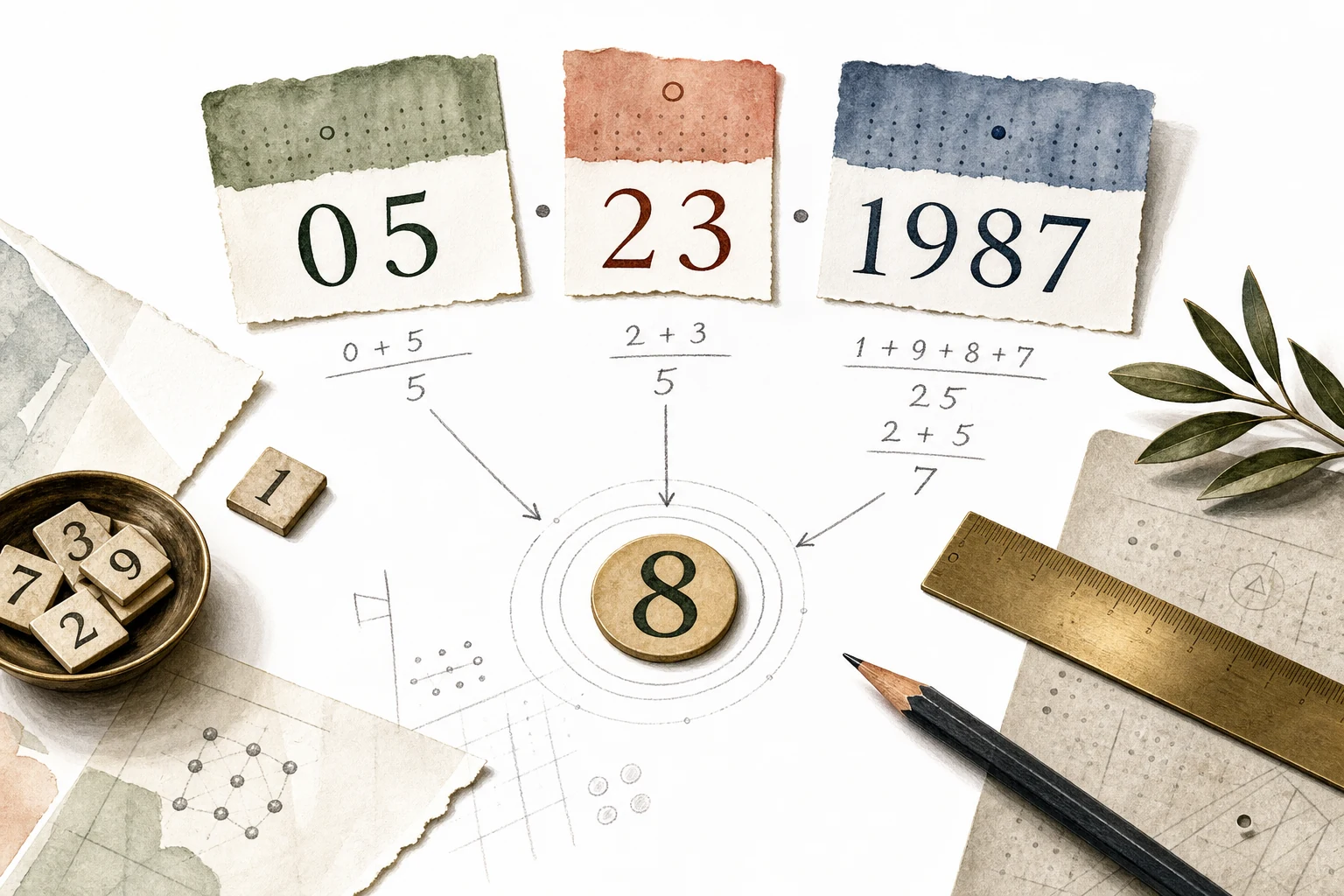
A handwritten birth date being reduced into a single number on an editorial field-note page
One date, several small sums, and a result that depends on the rules used to reduce it.
Full Birth DateInput
1–9, 11, 22, 33Standard Results
NoChanges Over Time
Not ValidatedScientific Status
01Overview

The Short Answer

Your birthday, reduced to one number

Arithmetic can be checked

Begin with the date you already know. Numerology takes its month, day, and year apart, reduces each piece, and adds the pieces back together. It is a little like dismantling a clock to discover that the final component is a number you had been carrying around all along.

For 12 August 1990, the month is 8, the day becomes 3, and the year becomes 1. Add them and you get 12; reduce 12 and you get 3. In this convention, the result is written 12/3 when the compound total is worth preserving.

That makes the calculation definite, but not the interpretation. Numerology traditionally associates 3 with expression and creativity. Whether that description feels useful is a matter for reflection; the arithmetic cannot prove the personality claim attached to it. Numbers are excellent at adding up. They are less qualified to testify about a stranger.

02CALCULATOR

Try It

Calculate your Life Path number

Enter your full date of birth. The result should display the month, day, year, combined total, and final reduction so the answer never arrives as a mysterious numeral from behind a curtain.

Uses the article’s declared convention: reduce month, day, and year separately.

The calculation can run entirely in the browser. Do not store or transmit a birth date unless the product explicitly needs that behavior and explains it to the user.

03THE CALCULATION

Under the Hood

How the date becomes a Life Path number

reduce(month) + reduce(day) + reduce(year) → reduce(total), while preserving 11, 22, and 33 according to the declared convention

Palm Hermit reduces the month, day, and year separately, preserves 11, 22, and 33 when they appear as master-number results, then reduces the combined total. Other numerology schools may use a different convention.

A standard result

Input: 12 August 1990

  1. 1. Reduce the month

    August = 8

    August is already a single digit.

  2. 2. Reduce the day

    1 + 2 = 3

  3. 3. Reduce the year

    1 + 9 + 9 + 0 = 19; 1 + 9 = 10; 1 + 0 = 1

  4. 4. Combine the pieces

    8 + 3 + 1 = 12

  5. 5. Reduce the total

    1 + 2 = 3

Result: 12/3

The 3 is the standard Life Path result; 12 records the compound total that produced it.

A master-number result

Input: 2 November 1998

  1. 1. Reduce the month

    November = 11

    Preserved as a master number under this convention.

  2. 2. Reduce the day

    2 = 2

  3. 3. Reduce the year

    1 + 9 + 9 + 8 = 27; 2 + 7 = 9

  4. 4. Combine the pieces

    11 + 2 + 9 = 22

    Preserved as a master number under this convention.

Result: 22 (master number)

Under this convention, 22 remains 22 rather than being reduced to 4. Some readers write it as 22/4 to show both layers.

  • • Using only the day of birth; that calculates a Birthday number, not a Life Path number.
  • • Reducing 11, 22, or 33 before checking the convention used by the calculator.
  • • Dropping the compound total and then wondering why another site shows 28/1 instead of 1.
  • • Assuming a different result proves that the birth date was entered incorrectly.
04REDUCTION RULES

The Small Print That Changes the Answer

Which totals are reduced—and which are kept?

Palm Hermit reduces the month, day, and year separately, preserves 11, 22, and 33 when they appear as master-number results, then reduces the combined total. Other numerology schools may use a different convention.

Reduced

101

10 becomes 1

Add 1 + 0. It may be displayed as 10/1 when the compound total is retained.

Preserved

1111

11 is preserved

Eleven is treated as a master number in this convention.

Reduced

123

12 becomes 3

Add 1 + 2. The fuller notation is 12/3.

Preserved

2222

22 is preserved

Twenty-two is treated as a master number rather than immediately reduced to 4.

Reduced

281

28 becomes 1

Add 2 + 8 = 10, then 1 + 0 = 1. It can be recorded as 28/1.

Preserved

3333

33 is preserved

Thirty-three is retained as a master number when it appears in an eligible final position under this convention.

05VISUAL GUIDE

Follow the Date

The calculation is a path, not a black box

A visual route from the three parts of a birth date to the combined total and final Life Path result.

  1. 1Separate the dateTreat the month, day, and year as three components.
  2. 2Reduce each componentAdd digits until the component reaches an allowed result.
  3. 3Preserve master numbersKeep 11, 22, or 33 where this convention calls for it.
  4. 4Add the componentsCombine the three reduced values.
  5. 5Read the resultKeep the final master number or reduce to a single digit.

Showing every junction makes disagreements between calculators much easier to locate.

06DIFFERENT ANSWERS

Why two calculators can disagree

A different result does not always mean a broken calculator. One tool may add every digit at once, another may reduce the date components separately, and the two may preserve master numbers at different stages. Compare the visible steps and convention before choosing which result your site will use.

06COMPOUND TOTALS

What 10/1, 12/3, and 28/1 are telling you

10/1

The final single digit is 1; 10 records the compound total that produced it. Standard Life Path lists normally file this result under 1, not under a separate Life Path 10.

12/3

The result belongs to Life Path 3, while 12 preserves the arithmetic route. Some traditions attach an additional interpretation to the compound number.

28/1

The calculation passes through 28, then 10, then 1. Retaining 28 prevents a precise calculation history from being flattened into a bare 1.

07NUMBER MEANINGS

The Traditional Map

What each Life Path number is said to mean

These are traditional associations used in Western numerology writing—not verified personality diagnoses.

Life Path

Life Path 1 The Initiator

Traditionally associated with independence, initiative, and learning how to lead without becoming isolated.

Often linked with: self-direction, courage, originality

Common frictions: impatience, stubbornness, going it alone

Life Path

Life Path 2 The Diplomat

Traditionally associated with cooperation, sensitivity, and the quiet work of keeping people connected.

Often linked with: listening, tact, partnership

Common frictions: indecision, over-accommodation, conflict avoidance

Life Path

Life Path 3 The Communicator

Traditionally associated with expression, imagination, and the discipline required to turn ideas into finished work.

Often linked with: creativity, sociability, verbal expression

Common frictions: scattered effort, avoidance, unfinished projects

Life Path

Life Path 4 The Builder

Traditionally associated with order, endurance, and constructing dependable things one unglamorous brick at a time.

Often linked with: discipline, practicality, reliability

Common frictions: rigidity, overwork, resistance to change

Life Path

Life Path 5 The Explorer

Traditionally associated with freedom, change, and learning the difference between variety and perpetual escape.

Often linked with: adaptability, curiosity, resourcefulness

Common frictions: restlessness, excess, inconsistency

Life Path

Life Path 6 The Caregiver

Traditionally associated with responsibility, care, and helping without quietly appointing oneself manager of everyone else's life.

Often linked with: loyalty, service, stewardship

Common frictions: perfectionism, interference, self-neglect

Life Path

Life Path 7 The Seeker

Traditionally associated with analysis, solitude, and the search for what remains true after the noise has left the room.

Often linked with: inquiry, concentration, discernment

Common frictions: withdrawal, skepticism, overthinking

Life Path

Life Path 8 The Executive

Traditionally associated with ambition, organization, and learning to handle power and resources responsibly.

Often linked with: management, persistence, strategic thinking

Common frictions: control, status fixation, work imbalance

Life Path

Life Path 9 The Humanitarian

Traditionally associated with compassion, completion, and caring for the whole without losing sight of the particular.

Often linked with: generosity, perspective, idealism

Common frictions: disillusionment, poor boundaries, difficulty letting go

Master number

Life Path 11 The Inspirer

Traditionally treated as a master number associated with sensitivity, intuition, inspiration, and unusual inner pressure.

Often linked with: vision, empathy, inspiration

Common frictions: nervous tension, self-doubt, impracticality

Master number

Life Path 22 The Master Builder

Traditionally treated as a master number joining large-scale vision with practical construction.

Often linked with: scale, organization, practical vision

Common frictions: pressure, overreach, fear of failure

Master number

Life Path 33 The Master Teacher

Traditionally treated as a master number associated with compassionate service, teaching, and responsibility.

Often linked with: care, guidance, devotion

Common frictions: self-sacrifice, idealism, unrealistic responsibility

08DO NOT CONFUSE THESE

Three Dates Wearing Different Hats

Life Path number versus Birthday number and Personal Year

Life Path number versus Birthday number and Personal Year
NumberBased onChanges?Traditional focus
Life PathFull date of birthNoBroad life themes and tendencies
BirthdayDay of the month onlyNoA particular talent or quality
Personal YearBirth month and day plus current yearYes, yearlyThe theme assigned to a particular year

These distinctions belong to numerological practice. They describe how the system organizes its calculations, not scientifically established influences.

09MYTHS

What a Life Path result does—and does not—show

Myth

Your Life Path number is simply the day you were born.

Reality

The Life Path calculation uses the full birth date. The day alone is normally called the Birthday number.

Myth

Everyone with the same Life Path number should have the same personality.

Reality

Numerology presents broad symbolic themes, not identical biographies. People sharing a result still differ in culture, biology, experience, opportunity, and choice.

Myth

A master number is automatically better than a single-digit number.

Reality

Within numerology, master numbers are usually described as more demanding, not as a league table of human worth.

Myth

Changing your name changes your Life Path number.

Reality

A Life Path number is derived from the birth date. Name changes may affect name-based calculations, but not this one.

10EVIDENCE

What can actually be checked?

Supported

A declared Life Path formula produces a reproducible result.

Once the date, reduction method, and master-number rules are fixed, another person can repeat the arithmetic and check every step.

Unsupported

The resulting number has been validated as a reliable personality measurement or predictor of life events.

The interpretive claims are part of numerological tradition. A repeatable calculation does not by itself validate the meanings attached to its result.

Unsupported

A profile feeling personally accurate proves that it was uniquely derived from the reader.

Research on personal validation shows that people can rate broad, identical personality descriptions as highly individual. This does not prove that every reading is meaningless; it does show why felt accuracy is not enough on its own.

Treat the calculation as transparent arithmetic and the profile as a traditional interpretive lens. The first can be verified line by line; the second should not borrow certainty from the first.

11EDGE CASES

Where the Neat Answer Frays

Cases that deserve a second look

  • The calculator returns 10, 12, 13, or 28

    These are usually compound totals. Continue reducing to 1–9 unless the result is a master number preserved by the selected convention.

  • Two sites disagree about a master number

    Check whether each site reduces the whole date at once or reduces month, day, and year separately, and where each one preserves 11, 22, or 33.

  • The profile does not sound like you

    First check the date and calculation. If they are correct, remember that a broad traditional profile is not an individualized psychological assessment. You do not have to make yourself fit it.

  • Your exact birth date is uncertain

    The formula needs a complete date. If the historical record is uncertain, the result is uncertain too; a calculator cannot repair missing information by confidence alone.

12DECISION TEST

A Useful Boundary

Should the number make decisions for you?

A useful boundary

Would you make the same important decision if the calculator had returned a different number?

If the answer is no, pause. A Life Path profile may prompt a useful question, but it should not choose a partner, career, investment, treatment, or major life change on your behalf.

13TAKEAWAYS

Keep These

Use your full birth date.

Supporting Finding

Reduce month, day, and year with one clearly stated method.

Important Limit

Keep 11, 22, and 33 only where that method says to preserve them.

Evidence Status

Read the meaning as tradition and reflection, not verified fact.

14FAQ

FAQ

Questions that usually appear after the answer

Can my Life Path number be 10?

In the convention used here, 10 reduces to 1. It may be written 10/1 to preserve the compound total, but it is normally interpreted under Life Path 1 rather than treated as a separate core Life Path 10.

Can my Life Path number be 11, 22, or 33?

Yes. These are commonly treated as master numbers and preserved when they appear in eligible stages of the calculation. The exact rule varies among numerology schools, which is why the method should always be shown.

Can my Life Path number change?

No under standard birth-date numerology, because the date used to calculate it does not change. A Personal Year number changes annually and is a different calculation.

Why did another calculator give me a different answer?

The calculators may use different reduction methods or preserve master numbers at different points. Compare the intermediate steps rather than only the final result.

Does everyone have a Life Path number?

Within the numerology system, any person with a complete birth date can be assigned one. That is a rule of the system, not evidence that the number objectively determines the person's life.

Is my birth date stored when I use the calculator?

It should not need to be. A simple Life Path calculation can run locally in the browser. The product should disclose clearly if it stores or transmits birth-date data for any reason.

15PERSPECTIVE

Perspective

What remains after the arithmetic

You began with three ordinary boxes on a form. After a handful of sums, they became a number with a name, a tradition, and a surprisingly large wardrobe of meanings. Keep whichever question helps you look at your life more carefully. The birthday itself can return to its quieter duties.

16SOURCES

Sources

Where the claims and methods come from