Calculations

What Personality Number Am I?

There's no quiz to take here, no multiple choice — just your own name and a chart that's been sitting around since the early twentieth century.

Working out your personality number is less like a personality test and more like solving a small, personal equation. Once you know the rule, the answer was always sitting inside your name.

Quick answer

To find out which personality number is yours, write your full birth name, circle every consonant, convert each to a number using a Pythagorean letter chart, add them up, and reduce the total to a single digit — or a preserved master number if the sum lands on 11, 22, or 33.

This is a walkthrough of the arithmetic behind the number, under one common convention. It does not establish that the result reveals anything verifiable about how you actually come across to others.

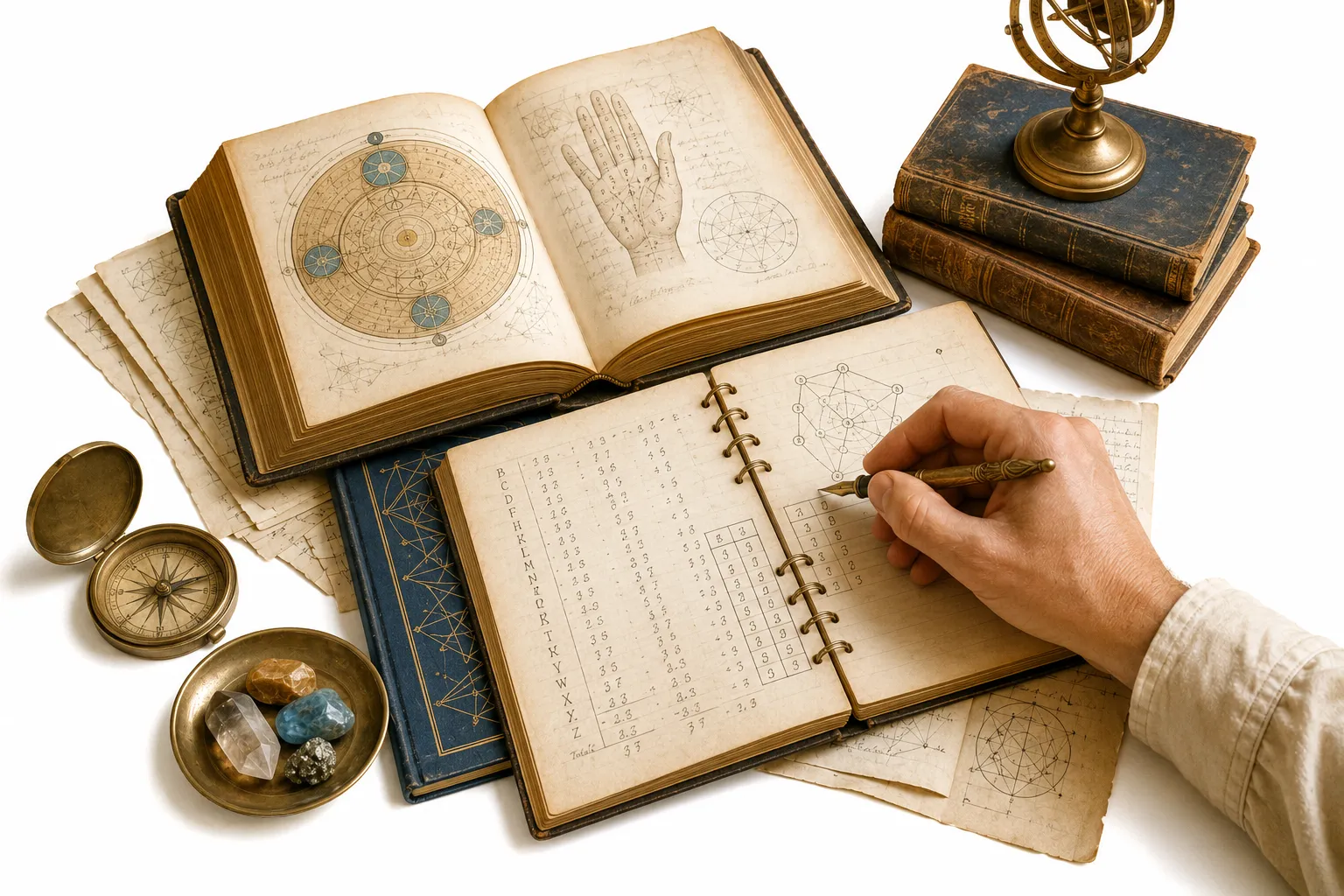
A person's birth name with consonants circled and numbered to determine their personality number
Under 2 MinutesTime Needed
Pen and Paper, or CalculatorTools
Consonants in Full Birth NameInput
1–9, or 11 / 22 / 33Result Range
Pythagorean · Birth Name · Master Numbers PreservedConvention Used
01Overview

Overview

Not a quiz — a calculation

Arithmetic can be checked

It's worth saying up front: there's no version of this question that a personality quiz can answer correctly. A personality number isn't assigned based on how you'd describe yourself — it comes entirely from the consonants already fixed in your birth name, run through a specific chart.

That makes the process more deterministic than most personality frameworks, for better or worse. Two people who share a birth name and the same calculation convention will always land on the same personality number; the calculation has no room for self-report.

02STEPS

Work it out in four steps

Step one: write your full birth name in capital letters, first, middle, and last.

Step two: circle every letter that isn't A, E, I, O, or U — including Y, which counts as a consonant under this page's convention.

Step three: below each circled letter, write its Pythagorean numeric value and add the whole set together.

Step four: reduce the total to a single digit by repeatedly summing its digits, unless it lands on 11, 22, or 33 and you're preserving master numbers.

03QUICK EXAMPLE

A quick example, start to finish

Worked Example Input: MAYA FOX

1. Consonant Letter Values

M=4
Y=7
F=6
X=6

2. Sum of Values

4 + 7 + 6 + 6 = 23

3. Single-Digit Reduction

2 + 3 = 5

Final Personality Number

5

A short, two-part name with no middle name and no master-number boundary keeps this easy to check by hand. For a longer example that includes a middle name and a compound total, see the full walkthrough.

04CHECKING YOUR WORK

Decision test

How do I know I did it right?

A useful boundary

Does your total reduce cleanly to a single digit, or land exactly on 11, 22, or 33?

If it does, you've almost certainly applied the chart correctly. If you land somewhere else after reduction, double-check that only consonants were included and that no letter was skipped or double-counted — those two mistakes account for most calculation errors.

05WHY RESULTS DIFFER

Why your personality number may differ between calculators

  • A different letter system

    Pythagorean numerology (used on this page) and Chaldean numerology assign different numeric values to the same letters, so the same name can produce genuinely different totals.

  • Whether master numbers are preserved here

    This page preserves 11, 22, and 33 if the total lands on them. Some tools reduce the Personality Number all the way to a single digit 1–9 regardless, on the reasoning that master numbers apply to other core numbers but not this one.

  • Reduction order

    This page sums every consonant across the full name, then reduces once. Some practitioners instead reduce each name part — first, middle, last — separately before adding those reduced digits together. The two methods can land on different final digits, especially near master-number boundaries.

  • How Y is treated

    This page always counts Y as a consonant. Others apply a phonetic rule where Y counts as a vowel when it makes a vowel sound and a consonant when it doesn't, which changes the consonant set for names like Lynn, Mary, or Bryn.

  • Which name was entered

    A birth name, a married or legal name, and a nickname are three different inputs. Different inputs produce different, not incorrect, results.

  • Whether the tool shows its method

    Many free calculators don't disclose which of the choices above they made, so a mismatch can look like an error when it's really an undocumented methodology difference.

06EDGE CASES

A few names that don't behave as expected

  • A name with almost no consonants

    A short, vowel-heavy name will simply produce a small consonant sum — there's no minimum threshold required for the calculation to work.

  • Double consonants in a row

    Both letters count separately — "Kelly" contributes both L's individually, not one combined value.

  • Hyphenated or multi-part surnames

    Standard practice includes every part of the legal surname; the hyphen itself isn't a letter and contributes nothing.

  • Using a married, chosen, or current legal name

    The standard convention calculates this number from the name on the original birth record. A married or legally changed name produces a different, separately meaningful number under this convention — not a corrected version of the birth-name result.

07IF IT DOESN'T FIT

If the number doesn't sound like you

Personality number is traditionally scoped narrowly — first impressions, not overall character — so a result that doesn't feel like "you" isn't a sign the arithmetic went wrong. It's answering a specific, limited question.

People comparing this result against their own sense of self often find their life path, expression/destiny, or soul urge number resonates more strongly instead. That's a difference in which question each number is answering, not evidence that this one is broken.

How closely any of these descriptions land is a matter of personal read, not something that can be verified the way the arithmetic can — worth keeping separate in your own head from the calculation itself.