Master Numbers

Which Numbers Are Master Destiny Numbers?

Numerology has one rule it breaks on purpose.

Everything reduces to a single digit — except three specific totals, which most schools stop and leave alone.

Quick answer

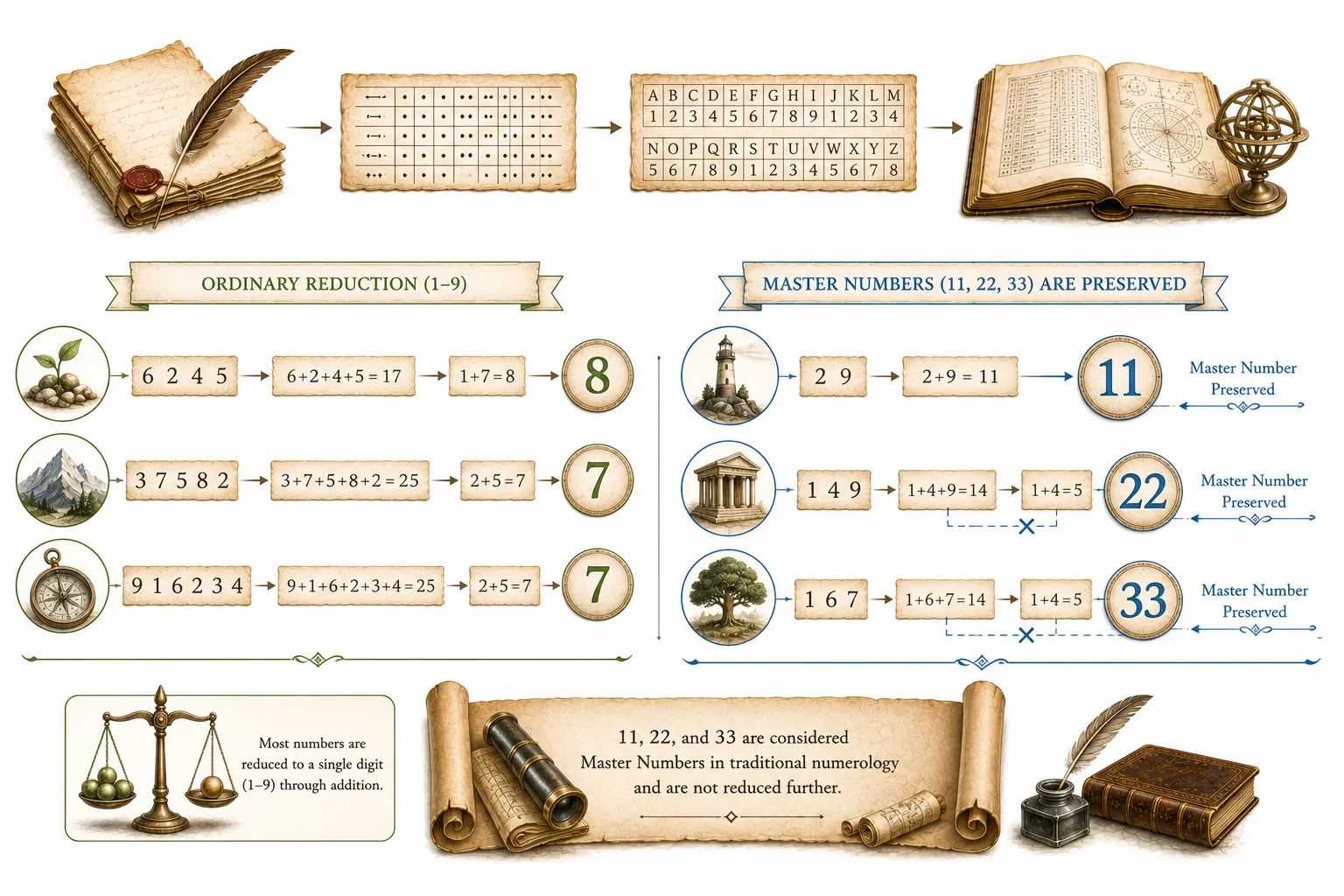
In mainstream Western numerology, the master numbers are 11, 22, and 33. When a destiny number calculation lands on one of these totals, most schools preserve it rather than reducing it further (11 to 2, 22 to 4, 33 to 6). Some practitioners also recognize 44 and beyond, though that's far less standard.

This page describes numerology conventions around master numbers. It does not assert that any number predicts personality, success, or life outcomes.

Three pairs of doubled numerals — 11, 22, and 33 — set apart from a row of ordinary single digits
11, 22, 33Standard set
44 and upLess common
Not reduced by conventionRule
Not empiricalEvidence
01Overview

Overview

A short list, held together by a shared shape

Interpretation is traditional

Master numbers share an obvious visual trait: repeated digits. 11, 22, and 33 are the only two-digit totals in the standard single-to-nine range that double a digit against itself, and numerology has treated that repetition as symbolically significant since at least the early twentieth century.

The practical effect is a pause button on the usual reduction rule. A destiny number calculation that lands on 29, for instance, reduces normally to 11 — and then most schools stop, rather than continuing on to 1 + 1 = 2.

Not every school agrees on where the list ends. 11, 22, and 33 are close to universal; some newer or more expansive systems extend the idea to 44, 55, and beyond, though that's a minority position most core Western numerology texts don't include.

02THE LIST

The three master numbers and their reduced alternatives

Preserved

1111

Master number 11

Traditionally read as intensified intuition and insight — a heightened version of 2's cooperative, perceptive qualities.

Preserved

2222

Master number 22

Often called the "master builder" — traditionally read as the ability to turn big visions into real, large-scale results, an intensified version of 4's structure and discipline.

Preserved

3333

Master number 33

Traditionally called the "master teacher," read as an intensified version of 6's care and responsibility, extended toward guiding or uplifting others on a larger scale.

03DISAGREEMENTS

Where sources actually disagree

  • Whether to preserve master numbers at all

    A meaningful minority of numerology practitioners reduce every total to a single digit regardless, treating 11, 22, and 33 the same as any other intermediate sum. Both approaches are common enough that it's worth stating which one a given source uses.

  • Whether the list extends beyond 33

    A small number of modern sources treat 44, 55, or higher repeated-digit totals as master numbers too. This isn't part of the classical Western system most calculators use, so treat it as an outlier position rather than a standard.

  • Master numbers appearing mid-calculation, not just as a final total

    Some schools preserve 11 or 22 even when it shows up as an intermediate sum before further reduction; others only apply the rule to the final result. This can produce different final numbers from the identical starting name or date.

04TAKEAWAYS

Verdict

The standard master numbers in Western numerology are 11, 22, and 33.

Supporting Finding

Most schools preserve them rather than reducing to 2, 4, or 6.

Important Limit

Some sources extend the concept further, but that's not the mainstream position.

Practical Use

Which rule a calculation uses should always be stated, since it can change the result.