Documented Biographical Investigation

Who Was Cheiro? The Man Behind the Palmistry Legend

Few figures in the history of fortune-telling created a more magnetic public persona than "Cheiro." To late-Victorian society, he was an enigmatic seer who advised kings, prime ministers, famous authors, and Hollywood stars under an assumed aristocratic title.

Behind the dramatic celebrity stories and mysterious aristocratic aura lay a real human being: William John Warner (1866–1936), an Irish-born author, publisher, and master self-promoter who transformed 19th-century hand reading into a global publishing empire.

This study separates documented historical facts—such as birth records, census data, published works, and copyrighted hand prints—from retrospective self-mythologizing and unverified press legends.

Cheiro was the P.T. Barnum of palmistry: an exceptionally talented reader who understood that in modern society, branding and mystery are just as potent as technical skill.

Quick answer

Cheiro was the professional moniker of William John Warner (1866–1936), born in Dublin, Ireland. Also writing under the pseudonym "Count Louis Hamon," he established famous reading rooms in London and New York, collected ink hand impressions from prominent figures like Mark Twain and Sarah Bernhardt, and published best-selling books that standardized modern palmistry terminology worldwide.

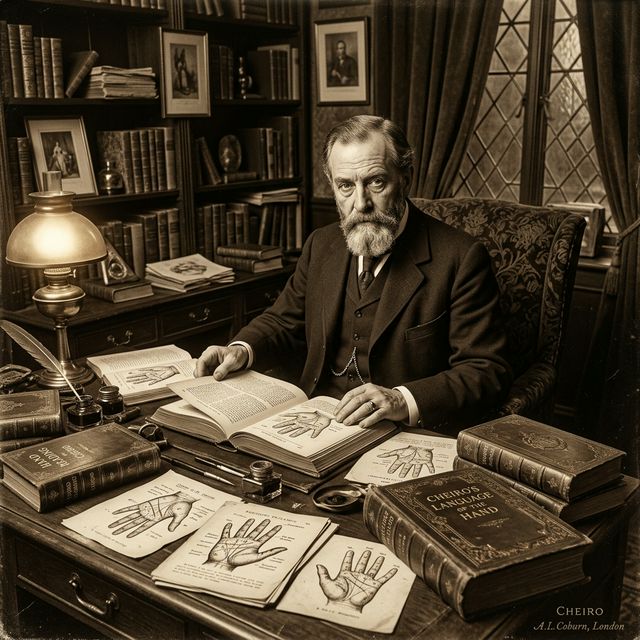
Historical portrait of Cheiro (William John Warner) alongside his vintage hand print books
William John Warner ('Cheiro') transformed hand reading from fairground fortune-telling into a high-society literary phenomenon.
William John WarnerReal Name
1866 – 1936Lifespan
Count Louis HamonAssumed Title
Language of the Hand (1894)Major Work
01Overview

Biographical Overview

The Man, The Brand, and The Historical Record

Understanding Cheiro requires distinguishing between three distinct entities: William John Warner (the historical Irish individual), "Cheiro" (his professional brand name derived from the Greek cheir, meaning hand), and "Count Louis Hamon" (his aristocratic literary persona).

While his 1927 autobiography Confessions: Memoirs of a Modern Seer presents his life as a romantic adventure filled with mysterious Indian gurus and infallible royal prophecies, archival census data, publishing registry entries, and newspaper records paint a more grounded story of a brilliant 19th-century entrepreneur.

Historical timeline

Origins, regions, and later reinventions

History pages read like museum notes: chronology first, then regional context and caveats.

02AT-A-GLANCE

At-a-Glance Verified Biography

Legal Name & Birth

Documented Archival Facts

William John Warner, born Nov 1, 1866, in Rathmines, near Dublin, Ireland.

Autobiographical / Popular Legend

Claimed aristocratic French-Norman lineage under the title "Count Louis Hamon."

Early Training

Documented Archival Facts

Study of 19th-century French palmistry manuals (d'Arpentigny and Desbarrolles) and London occult circles.

Autobiographical / Popular Legend

Claimed years of secret study in India with Brahmins who possessed an ancient gold book of hands.

Public Practice

Documented Archival Facts

Opened London salons in the early 1890s; published Language of the Hand in 1894.

Autobiographical / Popular Legend

Claimed to have read hands anonymously behind a curtain for royalty and world leaders.

Clientele

Documented Archival Facts

Documented ink hand prints of Mark Twain, Sarah Bernhardt, W.E. Gladstone, and Lord Kitchener.

Autobiographical / Popular Legend

Claimed flawless predictive forecasts for every major world event and royal death of his era.

Later Career

Documented Archival Facts

Moved to the United States; engaged in publishing, film screenwriting, and radio broadcasting in Hollywood.

Autobiographical / Popular Legend

Claimed to have foretold the exact year of his own death in 1936.

03REVEALING DETAIL

The Most Revealing Detail: The Visitor's Hand-Print Register

The most revealing historical detail about Cheiro's success was his genius for tangible evidence collection: his famous Guest Register of Ink Hand Impressions.

Unlike earlier palmists who relied solely on spoken readings, Cheiro asked every notable client to press their hand onto a glass plate coated with printer's ink, transferring their palm print onto high-quality paper.

When Mark Twain visited Cheiro's London salon in May 1895, Cheiro obtained a clear ink impression of Twain's hand. Twain subsequently wrote in the guestbook: "Cheiro has exposed my character to me with humiliating accuracy." Cheiro reproduced this physical hand print in his 1897 book edition, turning client endorsements into visual, copyrighted proof that catapulted his publishing career.

04SCOPE & STANDARDS

Research Scope and Evidence Evaluation

To construct an honest historical biography of Cheiro, historians evaluate three distinct tiers of evidence:

1. Primary Archival Records: Official birth/death certificates, UK census returns, British Library copyright registrations, and contemporary newspaper reporting.

2. Physical Artifacts: Original printed books, client hand-print lithographs, and signed visitor guestbooks.

3. Retrospective Autobiographies: Cheiro's own memoirs (Confessions, 1927; Fate in the Making, 1931), which are treated as valuable subjective accounts rather than objective historical truth.

05CHRONOLOGY

Chronological Life of William John Warner

1. Early Life and Dublin Origins (1866–1889):

Born William John Warner in Rathmines, Dublin, in 1866, he showed an early aptitude for theatrical showmanship and literature. As a young man, he moved to London, where he immersed himself in the booming occult revival of the late Victorian era, studying French chirognomy and orientalist literature.

2. The Creation of "Cheiro" and London Stardom (1890–1898):

Adopting the stage name "Cheiro" (derived from the Greek root for hand), Warner opened lavishly decorated reading rooms at 14 Upper William Street, London. He presented himself as a polished, sophisticated gentleman reader rather than a street fortune-teller. In 1894, he published Cheiro's Language of the Hand, an immediate bestseller that established his reputation across Europe and North America.

3. Transatlantic Success and Aristocratic Branding (1899–1919):

To expand his literary reach, Warner adopted the pen name "Count Louis Hamon," claiming aristocratic lineage. He traveled extensively between London, Paris, and New York, conducting readings for society figures, publishing magazine columns, and releasing books on numerology (*Cheiro's Book of Numbers*) and astrology (*When Were You Born?*).

4. Hollywood Years and Later Life (1920–1936):

In the 1920s, Warner relocated to California, capitalizing on the birth of Hollywood cinema. He wrote screenplays, edited newspapers, hosted radio broadcasts on hand reading, and authored his retrospective memoirs. He died in Hollywood, California, on October 8, 1936, at the age of 69.

06CONTRIBUTIONS

What Cheiro's Books Contributed to Palmistry

Cheiro's lasting impact on palmistry lies not in inventing new line names, but in how he revolutionized the presentation and popularization of hand reading:

• Visual Standardization: He was among the first authors to use clear, high-contrast full-page lithograph plates alongside actual client hand prints.

• Narrative Case Studies: He popularized the teaching technique of pairing line rules with memorable real-world client stories.

• Synthesis of Palmistry and Numerology: He integrated palm line reading with Chaldean numerology, creating a multi-system approach that influenced 20th-century popular occultism.

08CONTEMPORARIES

Cheiro Compared with His Contemporaries

Cheiro was not operating in a vacuum; he was part of a golden age of hand reading authors:

• Compared with Edward Heron-Allen (1885): Heron-Allen was a formal academic scholar who translated classical French texts; Cheiro was a mass-market communicator who brought palmistry to the general public.

• Compared with William G. Benham (1900): Benham wrote a clinical, 800-illustration diagnostic textbook; Cheiro wrote dramatic, intuitive character studies.

For a direct textual breakdown of their methods, see our guide: Cheiro vs William Benham: How Their Palmistry Methods Differ.

07REPUTATION VS RECORD

Reputation vs Documented Record: Predictions & Meetings

When evaluating Cheiro's famous client stories, historians distinguish between three levels of evidence: 1. Documented Meeting: Verifiable via ink hand prints or guestbook entries (e.g. Mark Twain, Sarah Bernhardt, Gladstone). 2. Documented Pre-Event Prediction: Verifiable in pre-event published print (e.g. predicting King Edward VII's death age in 1898). 3. Retrospective Legend: Stories published only in his 1927 memoirs long after events occurred (e.g. his famous retrospective claims regarding the Titanic). For a detailed investigation of his specific prediction claims, consult our dedicated article: Cheiro's Famous Predictions: What Is Documented, Disputed, or Unverified?

09TAKEAWAYS

Summary

Cheiro's real name was William John Warner (1866–1936), born near Dublin, Ireland.

Practical Use

He pioneered the use of actual ink hand prints in books, securing endorsements from figures like Mark Twain.

Important Limit

His pseudonym "Count Louis Hamon" was a literary brand created for Victorian society appeal.

Reader Guidance

He transformed palmistry into a respectable, mass-market publishing phenomenon that shaped 20th-century popular culture.

10FAQ

FAQ

Frequently Asked Questions

What was Cheiro's real name?

His birth name was William John Warner. He also published under the pseudonym "Count Louis Hamon" and practiced professionally as "Cheiro."

Did Cheiro really read Mark Twain's hand?

Yes. Cheiro obtained a verified ink hand print of Mark Twain in May 1895, and Twain wrote a signed testimonial in Cheiro's London guestbook.

What is Cheiro's most famous book?

His most famous work is Cheiro's Language of the Hand (first published in 1894), which went through dozens of editions and remains in print today.