Old Palmistry Diagrams Explained: How to Read the Original Illustrations
Looking at a 15th-century woodcut or a 19th-century French palmistry plate can be deeply confusing. Lines run in strange directions, fingers bear archaic Latin or German labels, and astrological glyphs cover the palm like a secret code.
These illustrations were not drawn to confuse modern readers; they followed strict visual conventions of their era. Scribes and woodcut carvers used stylized shorthand, mirror-image hand positions, and symbolic overlays that made perfect sense to readers in 1475 or 1859.
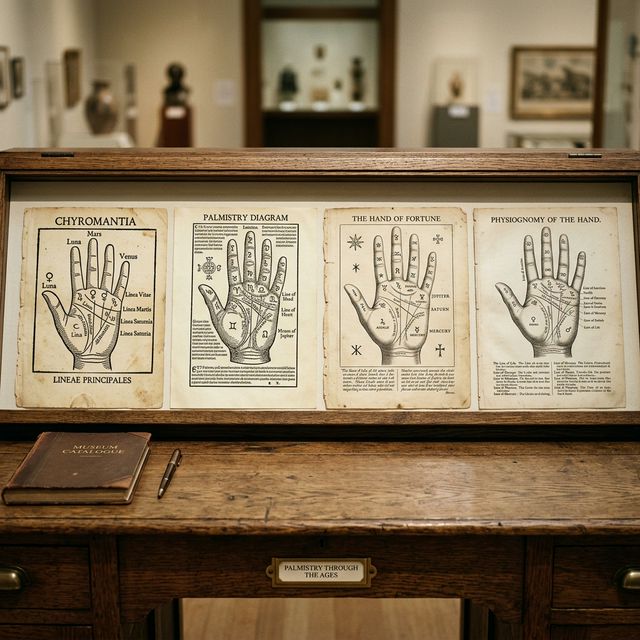
This guide decodes four representative historical diagrams from public-domain editions, explaining line names, symbol placement, hand orientation, and common reading traps.
Reading an ancient palmistry diagram is like deciphering a 15th-century sea chart: once you understand the compass rose and Latin legends, the map reveals its true path.
Quick answer
To read historical palmistry diagrams, you must overcome four main hurdles: hand orientation (many medieval woodcuts mirror left and right hands), label translations (translating Latin terms like Linea Vitae or Mensalis), symbolic overlays (distinguishing anatomical creases from astrological mount symbols), and artistic stylization (block-book woodcuts drew lines straight, whereas 19th-century plates drew natural curves).
Decoding archaic palmistry illustrations requires matching 15th-century Latin labels with modern palmar crease terminology.
1475, 1522, 1859, 1900 PlatesDiagrams Decoded
Public Domain / ArchivalRights Status
Reversed Orientation & Latin LabelsCore Hurdle
Woodcuts -> Lithographs -> Line ArtVisual Shift
01Overview
Visual Overview
Decoding the Visual Language of Historical Hand Reading
Historical palmistry diagrams are valuable windows into how past eras understood the human body, medicine, and destiny. However, modern readers often misinterpret old illustrations because line names and visual standards changed dramatically across centuries.
For example, what medieval codices called the Linea Mensalis (Table Line) is now known as the Heart Line; what they called the Linea Naturalis or Cephalica is now the Head Line; and what they called the Linea Vitae is the Life Line. Furthermore, early woodcut artists struggled to depict anatomical curves, rendering lines as rigid straight bars.
Historical timeline
Origins, regions, and later reinventions
History pages read like museum notes: chronology first, then regional context and caveats.
02DIAGRAM INDEX
Index of Inspected Historical Diagrams
Johann Hartlieb Woodcut
Date & Publication
1475 (Die Kunst Ciromantia, Augsburg).
Holding Archive / Source
Bayerische Staatsbibliothek / British Library.
Primary Teaching Feature
Earliest printed block-book lines; shows straight-line woodcut stylization and early German labels.
Renaissance medical hand chart; shows planetary mount symbols (Jupiter, Saturn, Apollo) on finger bases.
Rights Status
Public Domain (Pre-1929 printing).
Adolphe Desbarrolles Lithograph
Date & Publication
1859 (Les Mystères de la Main, Paris).
Holding Archive / Source
Bibliothèque nationale de France (BnF).
Primary Teaching Feature
19th-century French esoteric plate; introduces Kabbalistic lines and 7-hand shape typologies.
Rights Status
Public Domain (Pre-1929 printing).
William G. Benham Micro-Drawing
Date & Publication
1900 (Laws of Scientific Hand Reading, New York).
Holding Archive / Source
Library of Congress / G.P. Putnam's Sons.
Primary Teaching Feature
20th-century anatomical line art; isolates specific line breaks, splits, and island defects with extreme precision.
Rights Status
Public Domain (Pre-1929 printing).
03REVEALING EXAMPLE
The Most Revealing Example: Decoding the "Table Line" (Linea Mensalis)
The most common point of confusion in 15th- and 16th-century diagrams involves the horizontal line near the fingers. Modern readers immediately call this the "Heart Line," but historical diagrams invariably label it Linea Mensalis or "The Table Line."
Why "Table Line"? In medieval scriptoria, the palm region beneath the fingers was referred to as the Mensa (Table of the Hand). The line running along its border was thought to govern temperamental balance and hospitality.
When reading a 15th-century woodcut like Hartlieb's 1475 block-book, you will see the Linea Mensalis drawn as a harsh straight bar extending from the index finger to the edge of the palm. Understanding that this bar represents the modern Heart Line allows you to decode medieval interpretations of emotional capacity and physical stamina correctly.
04READING RULES
Hand Orientation and Label Conventions
1. Orientation and Thumb Positioning:
Medieval woodcuts frequently depicted hands with the thumb drawn on the right side of a left-hand palm or vice versa, creating apparent "anatomical impossibilities." This occurred because carvers carved woodblocks in relief; if they failed to mirror their drawing on the block, the printed image appeared reversed.
2. Latin Scriptorium Line Labels:
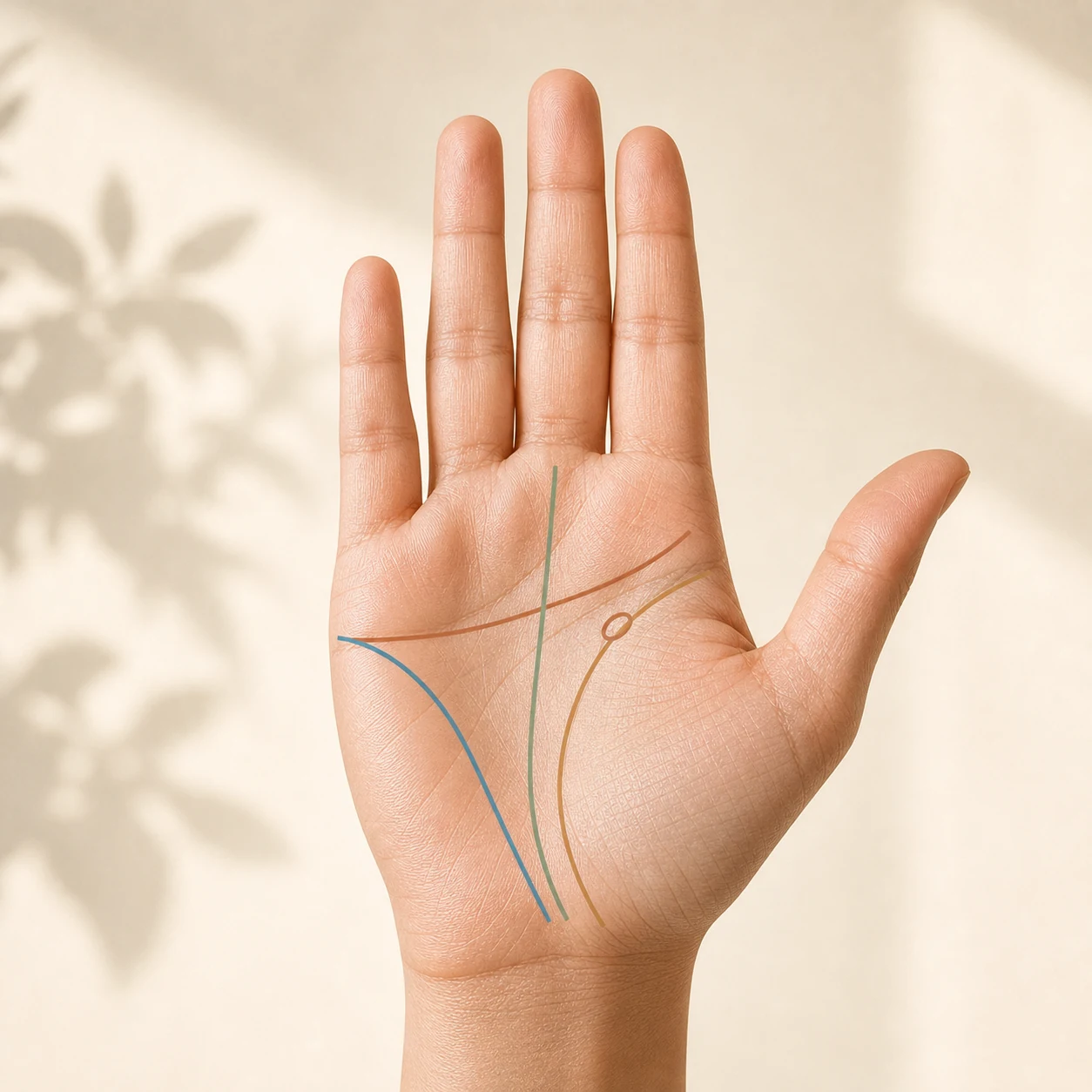
• Linea Vitae / Vitalis = Life Line (encircling the thumb).
• Linea Naturalis / Cephalica / Media = Head Line (crossing the palm center).
• Linea Mensalis / Superior = Heart Line (running beneath the fingers).
• Linea Recta / Saturnina = Fate Line (running vertically from wrist to middle finger).
• Linea Hepatica / Stomachica = Health Line / Liver Line (running diagonally toward Mercury).
05FIGURE BREAKDOWNS
Step-by-Step Breakdown of Inspected Historical Figures
Figure 1: Johann Hartlieb's 1475 Block-Book Hand (Augsburg):
• Source Details: Die Kunst Ciromantia (1475), Plate 1. Public Domain. BSB-München.
• What Is Shown: A crude woodcut of a left hand with broad, straight line cuts and German gothic text overlays.
• Decoded Labels: "Die tisch lini" (Table Line / Heart Line); "Die mittel lini" (Middle Line / Head Line); "Die leben lini" (Life Line).
• Reader Trap: The lines appear unrealistically straight due to the physical limitations of woodblock chisels. Do not mistake straight lines for a rare Simian line formation.
Figure 2: Johannes Indagine's 1522 Planetary Hand (Strasbourg):
• Source Details: Introductiones Apotelesmaticae (1522), Folio 14. Public Domain.
• What Is Shown: An elegant Renaissance line engraving placing astronomical symbols on finger bases (Jupiter ♃ on index, Saturn ♄ on middle, Sun ☉ on ring, Mercury ☿ on pinky).
• Decoded Labels: Planetary glyphs mark the "Mounts." The wrist is labeled "Rascetta" (wrist lines).
• Reader Trap: Modern readers often mistake planetary glyphs for physical birthmarks or tattoos. Indagine used them purely as symbolic territory markers.
Figure 3: Adolphe Desbarrolles' 1859 Esoteric Hand Chart (Paris):
• Source Details: Les Mystères de la Main (1859), Frontispiece. Public Domain. BnF.
• What Is Shown: A sophisticated French lithograph combining Kabbalistic Hebrew letters, planetary mounts, and detailed chirognomic finger tip classifications.
• Decoded Labels: Finger tips are labeled "Spatulée," "Carrée," "Conique" to demonstrate 7-hand shape typologies.
• Reader Trap: The heavy overlay of astrological terms reflects 1850s Parisian occultism, not pure anatomical palmistry.
Figure 4: William G. Benham's 1900 Micro-Line Defect Drawing (New York):
• Source Details: The Laws of Scientific Hand Reading (1900), Fig. 112, p. 240. Public Domain.
• What Is Shown: A clean, isolated black-and-white pen drawing showing a Head Line breaking into an island chain beneath Saturn.
• Decoded Labels: "Island on Head Line under Mount of Saturn."
• Reader Advantage: Benham eliminated decorative background flourishes, creating the clean visual standard used in modern technical manuals.
06VISUAL EVOLUTION
How Diagram Style Evolved from 1475 to 1900
Tracing these four diagrams reveals a dramatic evolutionary curve in visual communication:
• 15th Century (Block-Books): Crude woodcuts with straight lines, heavy gothic text, and mirror-image printing errors.
• 16th–17th Century (Renaissance Engravings): Refined copperplate engravings integrating astrological symbols and medical humors.
• 19th Century (Lithography): Intricate artistic plates showcasing whole-hand shape classification and esoteric symbolism.
• 20th Century (Technical Line Drawings): Isolated, unadorned anatomical line art focusing exclusively on micro-defects and functional clarity.
07VISUAL LIMITS
What Historical Diagrams Cannot Prove
Modern readers must remember: visual precision in an old diagram is not empirical proof of accuracy.
A beautifully engraved 16th-century copperplate depicting planetary mounts on the hand shows master artistic craftsmanship, NOT validated clinical medicine. Old diagrams show us what past authors believed and how they organized their ideas—they do not validate predictive fortune-telling.
08TAKEAWAYS
Summary
Map old Latin line labels (Mensalis = Heart Line, Cephalica = Head Line, Vitae = Life Line).
Supporting Finding
Beware of woodcut mirror-image printing errors that flip thumb placement.
Important Limit
Distinguish between anatomical palmar creases and symbolic planetary overlays on mounts.
Reader Guidance
Understand that crude straight lines in 15th-century woodcuts reflect chisel constraints, not rare line shapes.
09FAQ
FAQ
Frequently Asked Questions
What does "Rascetta" mean on old palmistry diagrams?
"Rascetta" is the traditional term for the horizontal wrist lines (bracelet lines) at the base of the palm, historically believed to indicate longevity and health.
Why are old palmistry diagrams written in Latin?
Latin was the universal academic and medical language of European scholars from the Middle Ages through the 17th century.
Are 19th-century palmistry illustrations public domain?
Yes. In most jurisdictions, books and illustrations published before 1929 are in the public domain, though individual high-resolution digital scans owned by museums may have specific usage terms.
10RELATED
Keep Exploring
If one line can supposedly reveal a future, what else do palmists claim to see?
Follow the questions readers most often ask next.
History & Tradition · 7 Questions
How palmistry ideas moved through cultures, texts, symbolic systems, and modern interpretation.