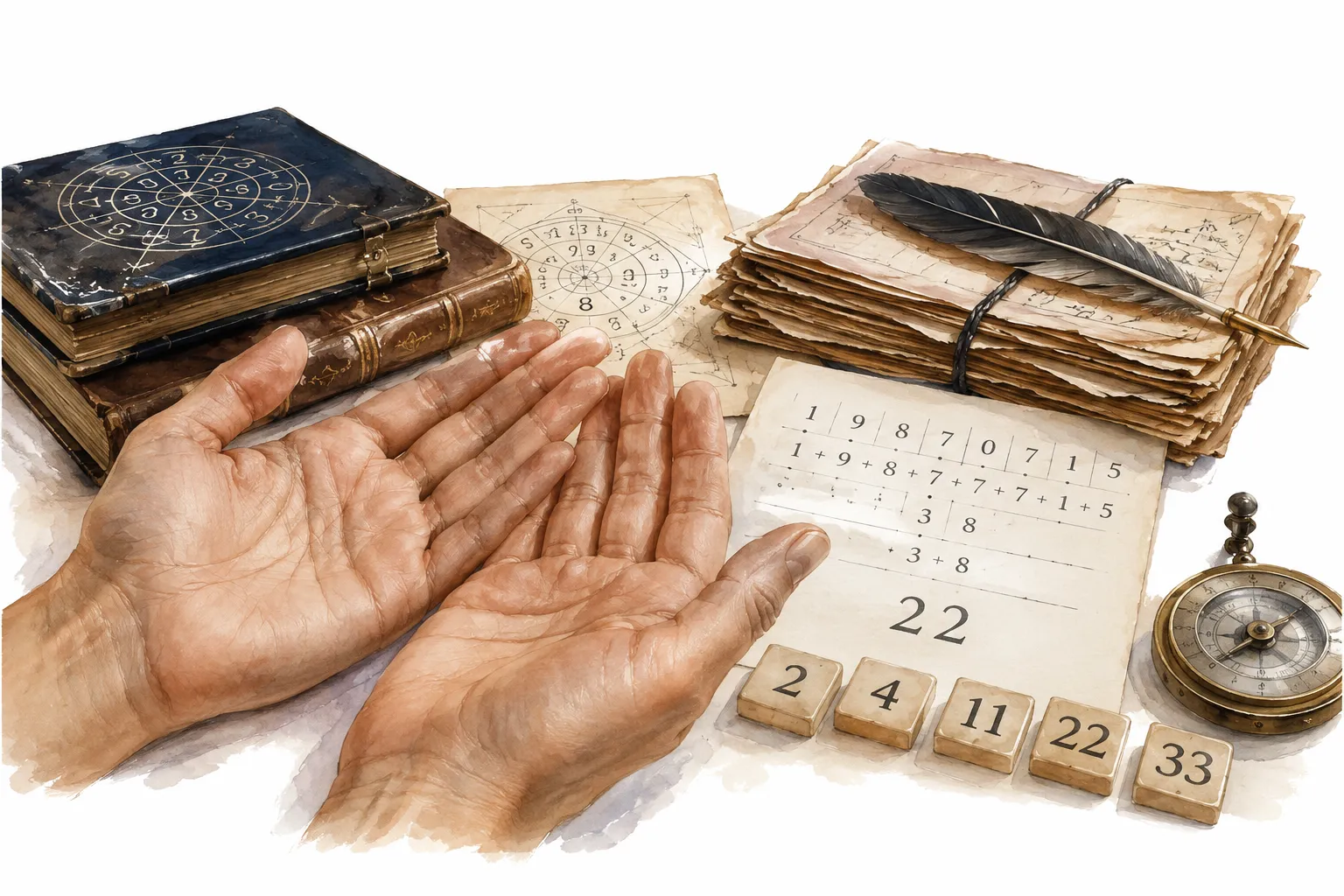
Master Numbers

Is 22 a Life Path Number?

Twenty-two shows up in far fewer birth dates than you'd guess — which is part of why the tradition around it grew so elaborate.

Numerology writers gave it a nickname: the Master Builder. What that's supposed to mean is a different question from whether it exists as a number.

Quick answer

Yes. Under the standard Western convention, a birth-date total of 22 is preserved as-is rather than reduced to 2 + 2 = 4, making it the second of the three commonly recognized master numbers.

This describes a numerology convention and its traditional nickname, not evidence about people who calculate this number.

The number 22 shown unreduced, beside its ordinary reduction to 4
YesMaster Number?
4Would Reduce To
Master BuilderTraditional Nickname
UncommonRarity
01Overview

Overview

The second exception to the reduction rule

Interpretation is traditional

Like 11, a total of 22 gets special handling in most Western numerology: instead of reducing to 4, it stays whole.

Numerology writing frames 22 as combining the traits associated with 11 and 4 — described as practical vision paired with the discipline to execute it. That's the tradition's language, not a testable claim.

Because 22 requires a specific combination of birth-date digits, it turns up less often than most single-digit numbers, which has fed its reputation as a rarer, weightier result.

02WHY IT'S KEPT

Why the reduction stops here too

The logic mirrors 11's: a repeated-digit total is treated by most modern Western schools as more significant intact than reduced, so 2 + 2 = 4 never happens under this convention.

Some numerologists go further and describe 22 as the most potent of the three master numbers, since it pairs the "vision" language attached to 11 with the "builder" language attached to 4. Framed as tradition, not fact.

03NEARBY TOTALS

22 next to its neighbors

Reduced

213

21 reduces to 3

2 + 1 = 3, ordinary reduction.

Preserved

2222

22 is preserved

Kept as a master number under the common convention.

Reduced

235

23 reduces to 5

2 + 3 = 5, back to ordinary reduction.

04NOTE

Rarity isn't proof of significance

A number being uncommon in the population doesn't make its traditional meaning more accurate — it just makes the number itself less frequent as a raw arithmetic outcome.