Master Numbers

Is 33 a Master Life Path Number?

Thirty-three behaves itself everywhere else in mathematics. It sits quietly between thirty-two and thirty-four, divisible by three and by eleven, causing no trouble whatsoever.

In numerology it gets treated like visiting royalty — waved past the usual reduction rules and allowed to keep both its digits. The practical question is whether that royal treatment extends to a Life Path number specifically, or whether 33 only pulls rank in other calculations.

The short answer is yes, in most systems. The longer answer explains why 33 is so much rarer than its two more famous relatives, 11 and 22 — and why a few numerologists quietly leave it off the guest list entirely.

A master number isn't a promotion. It's more like a passport that doesn't get stamped and simplified at the border the way everyone else's does.

Quick answer

Yes. In the majority of Western numerology systems, including Palm Hermit's convention, 33 is preserved as a master Life Path number rather than reduced to 6. A minority of schools recognize only 11 and 22, treating 33 as optional or "unlocked" only under specific conditions.

Master-number status is a convention chosen by a numerology system, and the traits attached to 33 are traditional interpretation — not a validated personality measurement.

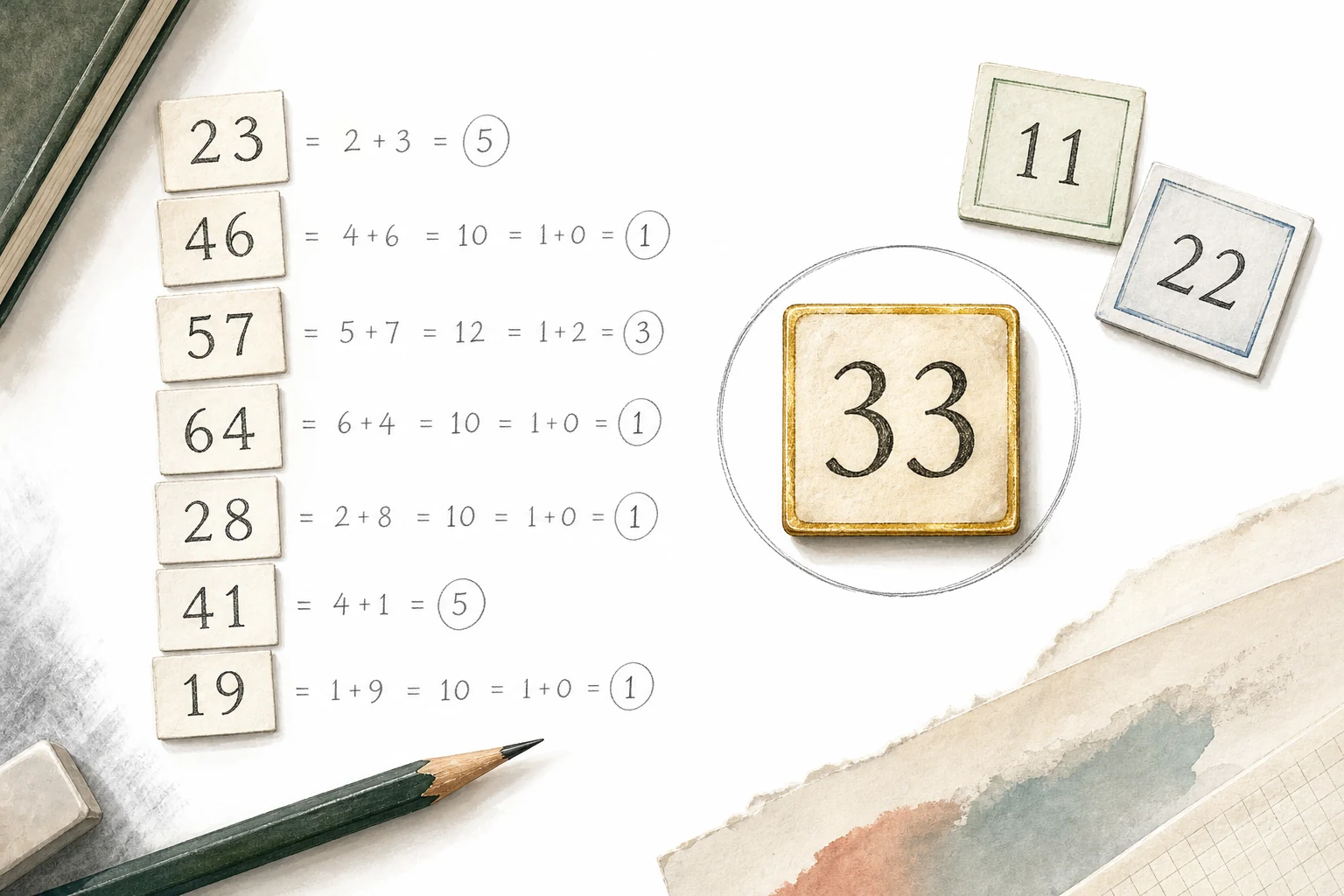
An editorial illustration of the number 33 standing apart from a reduced column of digits
Most totals get folded down to size. A rare few, including 33, are left standing.
Yes, in most systemsMaster Status
6Reduces To (if not kept)
11 and 22Shares the Tier With
Extremely rareReal-World Frequency
01Overview

The Short Answer

A number that's allowed to stay whole

Interpretation is traditional

Ordinarily, numerology treats a two-digit total the way a tailor treats extra fabric: trim it down until one digit remains. 12 becomes 3, 28 becomes 1, and so on, no exceptions — except for three numbers that get to keep both digits: 11, 22, and 33.

Of the three, 33 is the one you'll see debated. Some schools of Western numerology stop at 22, arguing that 33 only qualifies as a master number in narrower circumstances, such as certain name-based calculations. Palm Hermit's convention, along with most mainstream calculators, treats it as a full master number wherever it legitimately appears — including in a Life Path result.

What almost nobody disputes is that 33 is rare. A Life Path total of 33 requires an unusual alignment: it's the arithmetic equivalent of three separate dice all landing on the same unlikely number in the same roll.

02WHAT "MASTER" MEANS

A master number is a stop sign, not a bonus

Reduction normally has one job: keep adding digits until a single digit from 1 to 9 remains. A master number is simply an exception written into that rule — a place where the system says "stop here" before the final fold. 33 stopping at 33 is a decision built into the convention, the same way a recipe might say "don't overcook the eggs past this point." Nothing about the number itself demands the exception; the system grants it.

02WHY IT'S RARE

Why 33 is the rarest of the three

Eleven shows up whenever a component's digits happen to sum to 11 — a day of birth on the 29th, for instance, since 2 + 9 = 11. Twenty-two takes a bit more alignment. Thirty-three takes the most of all.

To reach a Life Path total of 33 under component-based reduction, the month, day, and year generally need to combine in a way that produces an unusually high sum before the final addition — often involving more than one master number appearing earlier in the same calculation. It isn't impossible, but it isn't common either, which is precisely why 33 carries more mystique per capita than 11 or 22: there are simply fewer people walking around with one.

That scarcity is a fact about how digits add up, not a hidden signal about destiny. A coin that lands on its edge is remarkable because edges are narrow, not because the coin was trying to tell you something.

0333 VS 6

Same Root, Different Treatment

Life Path 33 versus Life Path 6

Life Path 33 versus Life Path 6
AspectLife Path 6Life Path 33
Underlying digit63 + 3 = 6
Reduced further?Already single-digitNo — preserved by convention
Traditional themeResponsibility, care, stewardshipThe same themes, described as heightened and more demanding
FrequencyCommonRare

Numerologists who work with 33 usually describe it as Life Path 6 turned up several notches — the same responsibilities, carried with less room for error.

04THE DISAGREEMENT

Not every numerologist accepts 33

Myth

Every numerology tradition recognizes 33 as a master Life Path number.

Reality

A meaningful minority of practitioners restrict full master status to 11 and 22, treating 33 as either unavailable in Life Path calculations or requiring additional conditions to "unlock."

Myth

A Life Path 33 is automatically better than a Life Path 6.

Reality

Most sources describe master numbers as more demanding, not superior — a bigger job, not a bigger prize.

Myth

If your calculator shows 6 instead of 33, something is broken.

Reality

It likely means that calculator's convention doesn't preserve 33 in that position, or your birth date's arithmetic simply doesn't reach it. Compare the visible steps before assuming an error.

05EDGE CASES

Where It Gets Fiddly

Cases worth a second look

  • Your total is 33 only if you skip component reduction

    Some calculators sum every digit of the full date at once instead of reducing month, day, and year separately. The two methods can disagree on whether a 33 appears at all — always check which method produced your result.

  • You reach 33 through an unusual date

    A Life Path 33 typically requires multiple master numbers to appear earlier in the calculation. If your steps show 11 or 22 showing up more than once before the final total, that's the mechanism, not a coincidence to be alarmed by.

  • Two reputable sites disagree about whether 33 exists at all

    This is a genuine, documented split in numerological tradition rather than a bug. Neither site is lying to you; they're using different rulebooks.

06EVIDENCE

What can actually be checked

Supported

33 can appear as an unreduced total in a Life Path calculation under a stated convention.

This is a matter of following a declared arithmetic rule, and it can be checked step by step like any other sum.

Mixed

All numerology systems treat 33 as a master Life Path number.

Documented practice varies. Many systems include it; a meaningful minority restrict full master status to 11 and 22.

Unsupported

People with a Life Path 33 have been shown to share measurable traits.

This is a traditional interpretive claim. No independent measurement links a birth-date arithmetic result to personality outcomes.

Whether 33 shows up in your calculation is checkable arithmetic. Whether it means anything about you is a separate question, and a much older, fuzzier one.

07FAQ

FAQ

Questions people ask right after this one

Is 11 or 22 a master Life Path number too?

Yes, both are recognized as master numbers in the same tier as 33, and are preserved rather than reduced under most conventions, including 11 → kept, and 22 → kept.

What does Life Path 33 mean if it's not reduced to 6?

Traditionally, it's described as an intensified version of 6's themes — care, responsibility, and teaching — carried with unusually high stakes and self-expectation. This is interpretive tradition, not a measured trait profile.

Can a birthday alone produce a Life Path 33?

No. A Life Path number always requires the full birth date. A single day of the month can, at most, contribute a master number to one component of the larger calculation.

Why do some calculators never show 33?

That calculator's convention may cap master numbers at 22, or its date-reduction method may simply make a 33 total impossible to reach. Check its stated method before assuming a technical error.

08TAKEAWAYS

Keep These

Yes, most systems — including this one — treat 33 as a master Life Path number.

Practical Use

It's the rarest of the three master numbers because it needs the most unusual arithmetic alignment.

Reading Context

Its meaning is traditional interpretation; its presence in your calculation is checkable fact.

09PERSPECTIVE

Perspective

Rare doesn't mean chosen

A number that resists reduction is genuinely unusual, in the same modest way a four-leaf clover is unusual: worth noticing, not worth building a personality around. If your birth date produces a 33, you've found a small statistical curiosity sitting inside an ordinary calendar. What you do with that is entirely up to you — the arithmetic has already finished its part.

10SOURCES

Sources

Where the claims and methods come from

  • Master Numbers in Numerology

    Hans Decoz · World Numerology · accessed 2026-07-22

    Supports: Traditional definition and preservation rule for 11, 22, and 33; Traditional meaning associated with a preserved 33

  • Why Some Numerologists Don't Recognize 33

    Numerology.com · accessed 2026-07-22

    Supports: Documentation of the split between schools that do and don't grant 33 full master status