Comparative Textual Analysis

Palmistry Symbols Compared Across Classic Books: Where the Authors Disagree

If you search for the meaning of a single palmistry mark online—such as a star on the Mount of Saturn or a cross under the middle finger—you will almost certainly find contradictory answers. One site promises unexpected fame and fortune; another warns of grave misfortune or fatal accidents.

These contradictions are not modern internet inventions. They originate in the classic 19th- and early 20th-century literature of palmistry itself. When we compare foundational texts by Cheiro, William G. Benham, Adolphe Desbarrolles, and Edward Heron-Allen, we discover that even celebrated authors frequently disagreed on how specific markings should be interpreted.

This comparative guide examines six major markings—stars, crosses, islands, triangles, grilles, and line forks—across four classic manuals to reveal precisely where, why, and how the authors diverge.

Consulting different classic palmistry books for symbol meanings is like asking doctors from different centuries to diagnose the same X-ray: their readings depend heavily on the medical philosophy of their era.

Quick answer

Disagreements between classic authors stem from three main causes: location sensitivity (a star on Jupiter means ambition fulfilled, but on Saturn means tragic fatality), fatalism versus modification (Cheiro treats signs as unalterable verdicts, whereas Benham modifies sign meanings based on thumb strength and skin density), and terminology mismatches (confusing main line splits with accidental line intersections).

Comparative diagram of classic palmistry markings across four open 19th-century manuals
Comparing symbol definitions across classic texts shows that location and hand mechanics dramatically alter interpretive meaning.
Cheiro, Benham, Desbarrolles, Heron-AllenAuthors Compared
1859, 1885, 1894, 1900 TextsPrimary Works
Stars, Crosses, Islands, Triangles, Grilles, ForksMarkings Analyzed
Location & Modification Change MeaningsCore Finding
01Overview

Textual Overview

Why Classic Authors Interpret the Same Marking Differently

A common point of confusion for students of palmistry is expecting a "dictionary of signs" where every mark has one universal meaning regardless of context. In reality, classic palmistry literature treats markings as conditional signs whose interpretation depends heavily on location, line interaction, and hand shape.

Furthermore, 19th-century authors operated under different philosophical assumptions. French occultist Adolphe Desbarrolles sought esoteric astrological symbolism; British writer Edward Heron-Allen focused on rigid classical rules; Cheiro favored dramatic fatalistic readings for high-society clients; and American author William G. Benham introduced anatomical modification rules.

Historical timeline

Origins, regions, and later reinventions

History pages read like museum notes: chronology first, then regional context and caveats.

02COMPARISON MATRIX

Classic Marking Interpretations Compared

Star on Mount of Saturn

Cheiro (1894)

Tragic fatality; distinguished or catastrophic public death.

William G. Benham (1900)

Danger of paralysis or accident; mitigated if thumb is firm and head line strong.

Adolphe Desbarrolles (1859)

Fatal destiny, paralysis, or irresistible misfortune beyond personal control.

Edward Heron-Allen (1885)

Fated catastrophe or sudden elevation followed by terrible downfall.

Disagreement Nature

High agreement on tragedy; Benham differs by adding thumb modification rules.

Cross in Plain of Mars (Mystic Cross)

Cheiro (1894)

Mystical disposition, occult talents, and strong intuitive perception.

William G. Benham (1900)

Religious or superstitious interest; disposition depends on which mount it leans toward.

Adolphe Desbarrolles (1859)

Esoteric insight, religious devotion, and aptitude for hidden sciences.

Edward Heron-Allen (1885)

Self-deception or genuine occult aptitude depending on Head Line quality.

Disagreement Nature

General agreement on intuition; Benham & Heron-Allen add psychological caveats.

Island on Head Line

Cheiro (1894)

Severe mental weakness, hereditary brain affliction, or fatal head injury.

William G. Benham (1900)

Mental fatigue, eye strain, or temporary nervous exhaustion; specifies duration by line length.

Adolphe Desbarrolles (1859)

Brain illness or severe intellectual failure.

Edward Heron-Allen (1885)

Mental overwork or temporary brain illness.

Disagreement Nature

Moderate disagreement: Cheiro & Desbarrolles read organic illness; Benham reads functional overwork.

Triangle on Mount of Jupiter

Cheiro (1894)

Diplomatic skill, high political ambition, and leadership achievement.

William G. Benham (1900)

Scholarly distinction, diplomatic tact, and calm administrative ability.

Adolphe Desbarrolles (1859)

Grand diplomatic capacity and success in public affairs.

Edward Heron-Allen (1885)

Aptitude for statecraft and refined social ambition.

Disagreement Nature

High agreement across all four authors regarding diplomatic talent.

Grille on Mount of Venus

Cheiro (1894)

Uncontrolled passion, sensuality, and emotional volatility.

William G. Benham (1900)

Strong sexual energy; beneficial if balanced by a long, firm thumb and strong Head Line.

Adolphe Desbarrolles (1859)

Excessive amorous passion and lack of moral restraint.

Edward Heron-Allen (1885)

Unchecked sensual tendencies and emotional instability.

Disagreement Nature

Agreement on passion; Benham differs by treating it as physical vital energy to be directed.

Forked End of Head Line (Writer's Fork)

Cheiro (1894)

Dual literary talent, imagination combined with practical business sense.

William G. Benham (1900)

Adaptability of intellect; warning of deceit if fork is excessively wide or deep.

Adolphe Desbarrolles (1859)

Versatility of mind and talent for diplomacy or dramatic writing.

Edward Heron-Allen (1885)

Intellectual versatility, though risks indecision or hypocrisy if unbalanced.

Disagreement Nature

Minor disagreement: Cheiro frames positively (literary capacity); Benham warns of potential duplicity.

03SATURN STAR EXAMPLE

The Most Revealing Comparison: The Star on the Mount of Saturn

To understand how author philosophy shapes interpretation, consider the Star on the Mount of Saturn (located at the base of the middle finger).

Cheiro & Desbarrolles Interpretation: Both French occultist Desbarrolles and celebrity reader Cheiro view a star on Saturn as a sinister omen. Cheiro explicitly states that a star in this position signifies "a terrible fatality, a life ending in catastrophe, paralysis, or public disaster," citing historic case studies of executed royalty and doomed political figures.

Benham's Modification Approach: William G. Benham agrees that a star on Saturn indicates a concentration of negative Saturnian energy (nervous disorders, paralysis, or sudden accidents). However, Benham flatly rejects Cheiro's unalterable fatalism:

"If a star appears on Saturn, do not instantly pronounce a verdict of paralysis or murder. First inspect the thumb. If the thumb is long, stiff, and broad, the subject possesses the willpower and logic to avoid hazardous situations. Next inspect the Head Line: if it is clear and unblemished, the intellect will master the physical tendency."

This contrast illustrates the core divide: 19th-century occult readers issued unyielding prophetic verdicts, whereas 20th-century analytical readers viewed symbols as dynamic physical tendencies subject to mental control.

04BOOKS & METHOD

Inspected Books, Editions, and Terminology Matching

Primary Editions Inspected:

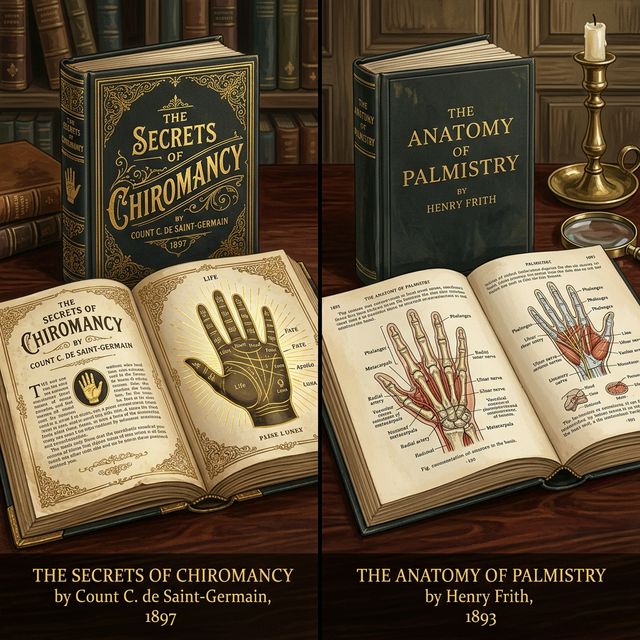
• Adolphe Desbarrolles: Les Mystères de la Main (Paris: 1859; 1865 15th Edition).

• Edward Heron-Allen: A Manual of Cheirosophy (London: Ward, Lock & Co., 1885).

• Cheiro (William John Warner): Cheiro's Language of the Hand (New York/London: 1894; 1897 facsimile edition).

• William G. Benham: The Laws of Scientific Hand Reading (New York: G.P. Putnam's Sons, 1900).

Methodology for Matching Signs:

1. Anatomical Location Precision: Comparisons were restricted to symbols located in identical palm regions (e.g. distinguishing a star on a mount from a star terminating a major line).

2. Visual Shape Verification: We verified that each author referred to the same geometric formation (e.g. distinguishing a genuine four-pointed star from an accidental intersection of three lines).

3. Contextual Adjustment: We noted whether the author interpreted the sign in isolation or mandated checking modifying factors (thumb size, skin consistency, line depth).

05INDIVIDUAL SYMBOLS

Detailed Analysis of Disagreed Markings

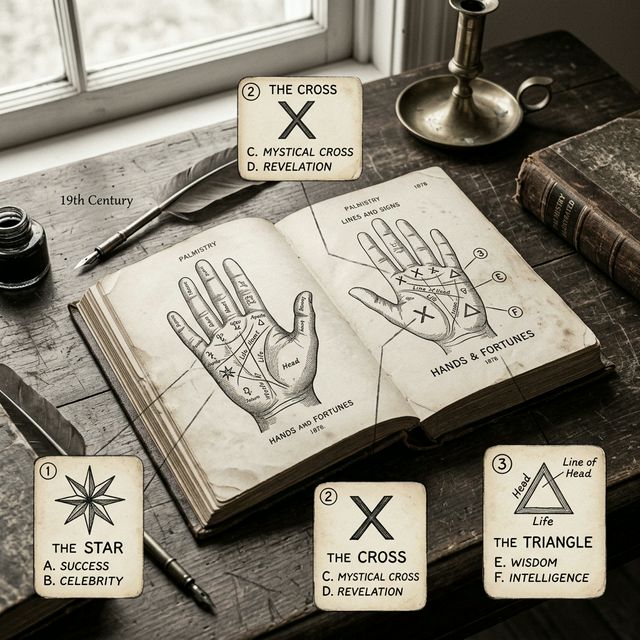
1. The Star (Étoile / Stella):

• Visual Definition: A center point with 3 to 5 radiating rays, distinct from main line paths.

• Location Disagreements: On Jupiter (index finger base), all authors agree it signifies honor and sudden elevation. On Saturn (middle finger base), Cheiro and Desbarrolles read fatal disaster, whereas Benham reads nervous exhaustion modified by thumb strength. On Apollo (ring finger base), Cheiro promises sudden brilliant fame with wealth, while Heron-Allen cautions that fame may come without financial reward if the Line of Sun is weak.

2. The Cross (Croix):

• Visual Definition: Two intersecting line segments forming an 'X' or '+'.

• Location Disagreements: The "Mystic Cross" (located in the quadrangle between the Head and Heart lines under Saturn/Apollo) is interpreted by Cheiro as an unmistakable sign of occult power and prophecy. Benham reinterprets it as an interest in religion or mystery, warning that on a soft, weak hand it produces foolish superstition rather than genuine wisdom.

3. The Island (Île / Insula):

• Visual Definition: An oval division where a line splits into two branches and reunites.

• Location Disagreements: All authors agree islands represent weakness or obstruction. However, on the Head Line, Desbarrolles reads organic brain disease or insanity; Cheiro reads severe head injuries or hereditary weakness; Benham reads temporary mental overwork or eye strain. Benham's functional interpretation offers a far more optimistic and practical perspective.

4. The Triangle (Triangle):

• Visual Definition: A distinct three-sided geometric figure formed by independent minor lines or mount markings.

• Location Disagreements: High agreement exists for triangles on mounts (indicating scientific or diplomatic aptitude). Disagreement arises on major lines: Cheiro treats a triangle attached to the Life Line as a sign of military glory or physical rescue, whereas Benham views it as a structural defense mechanism protecting a weakened segment of the line.

5. The Grille (Grille):

• Visual Definition: A grid of intersecting vertical and horizontal fine lines on a mount.

• Location Disagreements: All authors agree grilles represent obstructed or exaggerated mount energy. On the Mount of Moon, Cheiro and Desbarrolles read restless melancholy or drowning risks; Benham reads kidney troubles, gout, or over-imaginative worry.

6. Line Forks and Splits:

• Visual Definition: A major line dividing into two or three distinct branches at its terminus.

• Location Disagreements: At the end of the Head Line, Cheiro labels a downward fork into the Mount of Moon as the "Writer's Fork" (combining logic and imagination). Heron-Allen and Benham agree on versatility, but Benham warns that if one branch drops too steeply toward the wrist, it signifies intellectual instability or deceptive habits.
06DISAGREEMENT PATTERNS

Categorizing the Patterns Behind Author Disagreements

Analyzing these discrepancies reveals four underlying patterns that account for nearly all author disagreements in classic literature:

1. Fatalistic vs Modification Frameworks: 19th-century French occultists (Desbarrolles) and celebrity readers (Cheiro) treated symbols as deterministic fate markers. 20th-century empirical readers (Benham) treated symbols as physical tendencies modified by thumb willpower and head line intellect.

2. Organic Disease vs Functional Overwork: Early writers interpreted line defects (islands, spots, breaks) as permanent organic organ failures or severe physical traumas. Later clinical writers recognized them as temporary functional overwork, stress, or nervous fatigue.

3. Terminology and Visual Misidentification: Many disagreements stem from confusing an isolated geometric mark with random accidental lines (criss-crossing stress creases).

4. Cultural and Historical Context: Desbarrolles wrote for 1850s Parisian esoteric salons; Benham wrote for 1900s American readers interested in practical self-improvement.

07INTERNET MYTHS

Common Internet Simplifications vs Inspected Texts

Myth

Internet Claim: "A star on your hand always means you will be super famous."

Reality

Inspected Texts: False. Authors unanimously state that location is critical: a star on Jupiter or Sun brings fame, but a star on Saturn or Mars indicates tragedy or conflict.

Myth

Internet Claim: "An island on any line means your life is ruined."

Reality

Inspected Texts: False. Benham demonstrates that islands frequently denote temporary periods of overwork, illness, or strain that clear up as the line continues smoothly beyond the island.

Myth

Internet Claim: "The Mystic Cross gives you supernatural psychic powers."

Reality

Inspected Texts: Desbarrolles and Cheiro note mystical intuition, but Benham and Heron-Allen emphasize that on a weak hand, it merely produces foolish superstition.

08PREDICTIVE LIMITS

Why Textual Agreement Does Not Establish Empirical Validity

A crucial distinction for modern readers: when Cheiro, Benham, Desbarrolles, and Heron-Allen agree on a sign (such as a star on Jupiter representing high ambition), their consensus proves historical textual tradition, NOT modern empirical proof. Textual agreement demonstrates that 19th-century authors shared common symbolic conventions derived from classical astrology and French chirognomy. It does not mean double-blind scientific trials have validated palm signs as predictive tools for external future events. Modern readers should value these comparisons as rich cultural and observational history.

09TAKEAWAYS

Summary

Never read a palm symbol in isolation: location, line depth, thumb strength, and palm texture alter its meaning.

Supporting Finding

Disagreements between Cheiro and Benham reflect a shift from 1890s fatalistic fortune-telling to 1900s dynamic psychological analysis.

Important Limit

Apparent contradictions online often stem from mixing up different classic authors without acknowledging their modifying rules.

Reader Guidance

Always check whether an apparent symbol is a genuine isolated mark or just random overlapping stress creases.

10FAQ

FAQ

Frequently Asked Questions

Why do different palmistry books say different things about the same sign?

Different authors wrote in different eras under different philosophies. French occultists like Desbarrolles focused on astrological symbolism, whereas American authors like Benham focused on hand mechanics and thumb modification.

Which author's symbol interpretations are most reliable?

Benham (1900) is widely considered the most thorough and practical because he provides clear rules for modifying sign interpretations based on hand consistency and thumb strength.

How can I tell if a star or cross on my hand is real?

A genuine palmistry symbol consists of distinct, intentional lines forming a clear geometric shape. It should not be formed by major lines crossing each other or random, faint skin creases.